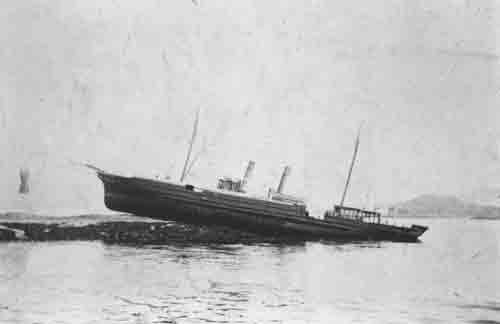
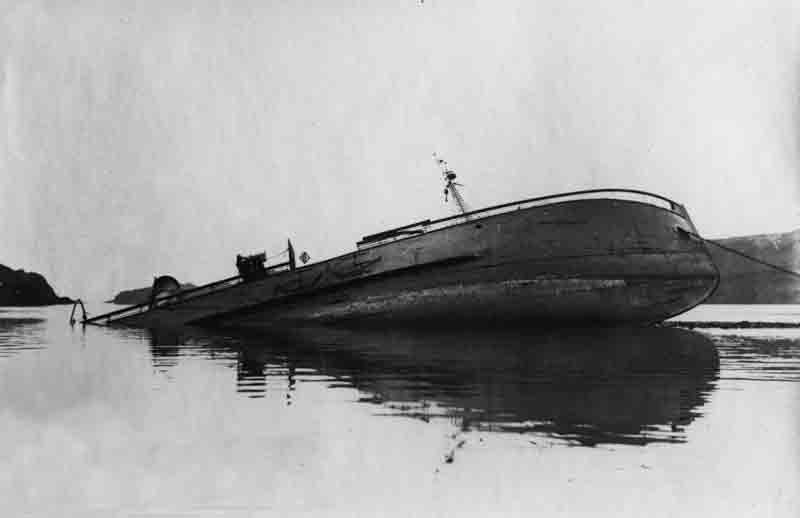
The steel steamship Serantes was launched from the yard of A Simey and Co Ltd.,Sunderland (Yard No 40) on 17th October 1872 for Johnson and Co Ltd of Newcastle. She measured 209.1′ x 28.6′ x 13.6′ and her tonnage was 715 gross tons, 425 net tons. She was powered by a 2 cylinder compound steam engine by J Stewart, London delivering 111 nominal horse power.

Lloyd’s Register 1915
She passed through the ownership of multiple British and Norwegian companies before she was acquired by E Aby of Drammen in 1905 who renamed her Fri. Only two years later she was purchased by N Olsen of Porsgrund who named her Venus. Futher ownership changes followed before she was purchased by Akties Dampskibs Venus of Kristiana in 1916.

Venus as SS Sif
She departed from Blyth at 06:00am on 14th April 1917 bound for Drammen with a cargo of coal and a crew of fifteen men aboard. After dropping off the pilot they steered a course close to the coastline and by 13:00 they were off four and a half miles east of Berwick. The second mate was on look out and a young seaman, Rolf Johanssen was at the wheel. The men on the bridge and on deck continuously scanned the surface wary of the German U-boats known to be operating in the area. Suddenly there was a violent explosion on the starboard side near the main hold. A number of the crew rushed to the lifeboat and quickly lowered it to the water but unfortunately the boat was sucked under as the Venus sank. The two life rafts that had been secured to the deck broke free as they were designed to do but they drifted off on the strong breeze before any of the remaining crew could reach them. Only one man, Einar Olafsen, survived clinging to some floating wreckage for an hour before he was picked up by a fishing boat that had raced to the scene to lend assistance. The Venus had struck a mine laid on 15th March by UC-50 under the command of Kapitanlieutnant Rudolf Seuffer.

A mine from barrage 41a sank the Venus.

Rudolf Seuffer
The wreck of the Venus lies in position 55° 48.144’N, 001° 51.700’W oriented 012°/192°. She sits upright, mainly in tact in 55 metres with a least depth clearance of 48 metres. The wreck was positively identified by recovery of bell in 2009.