Scottish Shipwrecks

Information and Pictures of Shipwrecks in Scotland

  • Home
  • About
    • About Clyde Shipwrecks
    • About Argyll Shipwrecks
  • Shipwrecks
    • Scottish Shipwrecks
    • 1 – Galloway & Solway Firth
    • 2 – Clyde
    • 3 – Argyll
    • 4 – NW Scotland & Outer Hebrides
    • 5 – North Coast & Orkney Isles
    • 6 – Shetland Isles & Fair Isle
    • 7 – North East Scotland
    • 8 – East Scotland
    • 9 – South East Scotland
  • GALLERY
    • GALLERY INTRODUCTION
    • VINTAGE VIEWS
    • WRECKLIFE
    • WRECKSHOTS
    • WRECKCLIPS
  • Book Sale
    • Argyll Shipwrecks
    • Clyde Shipwrecks
  • Blog

Clynder

The Clynder was a large barque rigged sailing ship built by Russell & Company of Port Glasgow (Yard No.41) and launched on 12th November 1881. Built to the order of the Glasgow based shipping company Thom & Cameron, the iron hulled general cargo vessel measured 215.5′ x 35.3′ x 21.1′ and her tonnage of 1145 gross tons. Her official number was 85874.

Lloyds register 1890

The Clynder left Tehio in New Caledonia on 5th August 1880 bound for Bowling on the Clyde with a cargo of 1785 tons of nickel ore. She was under the command of the master, James Roach, with a crew of twenty one men and two passengers, the master’s wife and child. On the 1st of December, when they were around 100 miles west of the Bay of Biscay, the main compass binnacle was hit by the foot of the mizzen mast after a sudden strong gust of wind and fell over.  The master did not feel that the incident had affected the accuracy of the compass but he was almost certainly wrong. Critically he did nothing to check it’s accuracy. By the 10th of December they spotted the Fastnet Light off their port bow and headed into the Irish Sea. He then set a course to pass close to the Isle of Man.
 
The next time they sighted land off their port bow the master wrongly concluded the land was St John’s Point, County Down but it was in fact the Isle of Man. A strong easterly flowing spring tide and, most likely, a faulty main compass placed them well east of their intended course. Despite sailing for nearly thirty six hours using only dead reckoning the appearance of another light off the port bow did not change his view. This time he concluded it was the light vessel off South Rock and that he was on course to sail into the North Channel past the west coast of Galloway. To finally seal the fate of the Clynder, as night descended, a thick fog enveloped the vessel. By now they were so far off course from the master’s calculated position that they were totally lost. Shortly after midnight on the 14th a dark shadow appeared through the night and fog. The second mate was at the wheel and he called the master to the bridge. The master went below again to study his chart but, by the time he returned to the deck and ordered a sharp turn to port, the ship was almost ashore. Minutes later they grounded. Thankfully the weather was calm and they had come ashore on a sandy stretch of the coast at Abbey Burn Foot near Kirkcudbright. The crew and passengers were safely evacuated but the ship was in difficult position. There appears to have been some swell at the time as the ship was bouncing heavily on large rocks as she stranded and three large holes were punched in her starboard bilge, flooding the hull and cargo spaces.

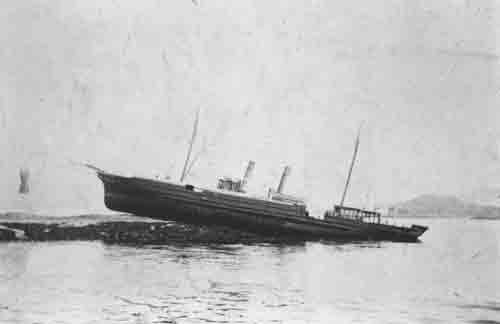
Clynder ashore at Abbey Burn Foot

Initial hopes were high that, if a third of her cargo was removed and the holes repaired, she might be refloated. Work commenced immediately to recover as much of her cargo as possible and the steamlighter Stormlight and local labour were put to work. A tug and powerful pumps were also sent south to the wreck site. Regular reports from the Salvage Associations local officer appeared in Glasgow newspapers and, by the 16th December with the weather was holding, more cargo had been discharged but then rock below the bilges had to be blasted before hull repairs could be made. By this stage the Clynder was broadside to the beach with a list to seaward and the aft end was awash at high tide.

By the 20th December reports did not make such good reading. Overnight strong winds had further moved the ship along the beach. An inspection took place at low water revealing the decks to be set up in the aft section, the beams between the two main decks bent and the remaining cargo was being washed out of the holds.  There was no prospect of the current salvage plan working. As a result the tug and pumps were sent back to Greenock. The only hope now was to discharge all the cargo. A temporary road to the wreck and a platform was constructed alongside. The Clynder finally succumbed to the elements during a southerly gale late on Monday 22th December into the following day The masts collapsed into the sea and the hull went to pieces with what remained of her cargo washed onto the surrounding beach. 

A Board of Trade inquiry held into the loss of the Clynder in January 1891 found that the cause of the loss the failure of her captain to verify his position after noon on 13 December when he found himself a long distance from where her intended to be. The vessel had not been navigated in a proper and seamanlike manner and the captain was in default. The Board suspended Captain Roach’s certificate for 6 months.


The wreck, the remaining cargo and salvaged effects were put up for auction on 26 March 1891. It is not clear the outcome of this although the Galloway Gazette of 3 July 1891 notes that samples of the remaining cargo had been taken to establish its worth and potential use.

As for the Clynder some remains may still lie on on the beach 50-100 metres east of Netherlaw Rocks at Abbey Burn Foot in position 54° 46.687’N  03° 57.481’W.

Share this:

  • Click to share on Facebook (Opens in new window) Facebook
  • Click to share on X (Opens in new window) X
  • More
  • Click to print (Opens in new window) Print
  • Click to email a link to a friend (Opens in new window) Email

Subscribe to Blog via Email

Enter your email address to subscribe to this blog and receive notifications of new posts by email.

Our Social Media Sites


Shipwreck Slideshow

Admiral Cordington Barcombe Belford Bombardier Brigadier Clydesdale Cormoran Coronella Dunira Grenadier Harald Hereford Express Islay Kathleen Stromboli Lapwing II Laverock Milewater Mountaineer Norse Paulina Hexpress Pirate Pretorian Princess Patricia Rondo Tyrconnel Agios Minas

Site built and hosted by Braveheart Webdesign Islay