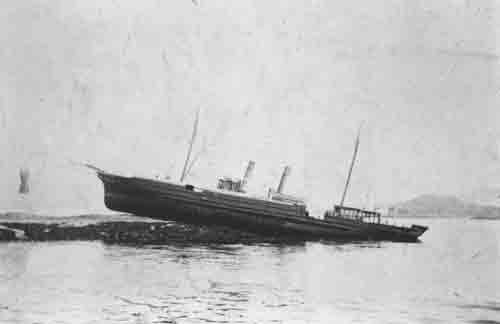
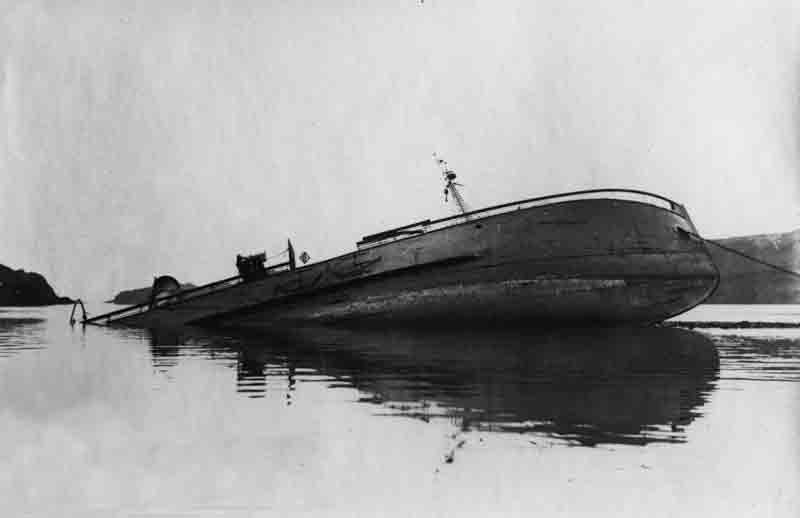
The Rondo was built in the US in the last frantic months of World War 1. The 2363 gross ton, 1333 net ton steel steamship was launched by the Tampa Shipbuilding & Drydock Company in 1917. Her dimensions were 264.0′ x 42.0′ x 21.2′. She was powered by a triple expansion steam engine manufactured by her builders delivering 294 nominal horse power. She had been ordered under the cover of the Cunard Steamship Company to avoid contravening America’s neutral status but before she was complete America had entered the war and the disguise had become unnecessary. She had been built for the British Shipping Controller as War Wonder 1 but she did not complete fitting out till September 1918 and effectively missed the closing action of the war. Instead of joining the British freight fleet she became the property of the United States Shipping Board who named her Lithopolis. In 1930 she was sold to A/S Torsborg, Porsgrund who named her Laurie and finally, purchased by Bucha Godager and Co, Christiana in 1934 who named her Rondo.


Lloyds register 1935
In January 1935 the Rondo was in Glasgow and departed for Dunstan, Northumberland in ballast intending to sail north round the top of Scotland and down the east coast to her destination where she was due to pick up a cargo for Oslo. As she sailed north and into the Sound of Mull on the 25th the weather was atrocious. She was forced to anchor in Aros Bay near Tobermory for shelter in a blinding snowstorm. As the crew settled down for an uncomfortable night the anchor chain parted and she started to drift east down the Sound driven by the strong winds and the tide. The crew were powerless to guide the helpless ship in the darkness and could only hope that they would be lucky but this was not to be the case. The Rondo was swept onto Dearg Sgeir near Eileanan Glas almost demolishing the small lighthouse as she crashed ashore and stuck fast, high and dry on the rock.

The twenty-two crew were in no danger but fired distress flares to attract the attention of nearby ships. As the new day dawned the Rondo was sitting securely astride the small rock and preparations began for a salvage attempt. The crew remained aboard for two weeks hoping that something could be done to save her but eventually she was abandoned to be broken up where she lay. This activity was well under way when she finally slipped off the rock and sank, bow first, in the deep water close to the island.

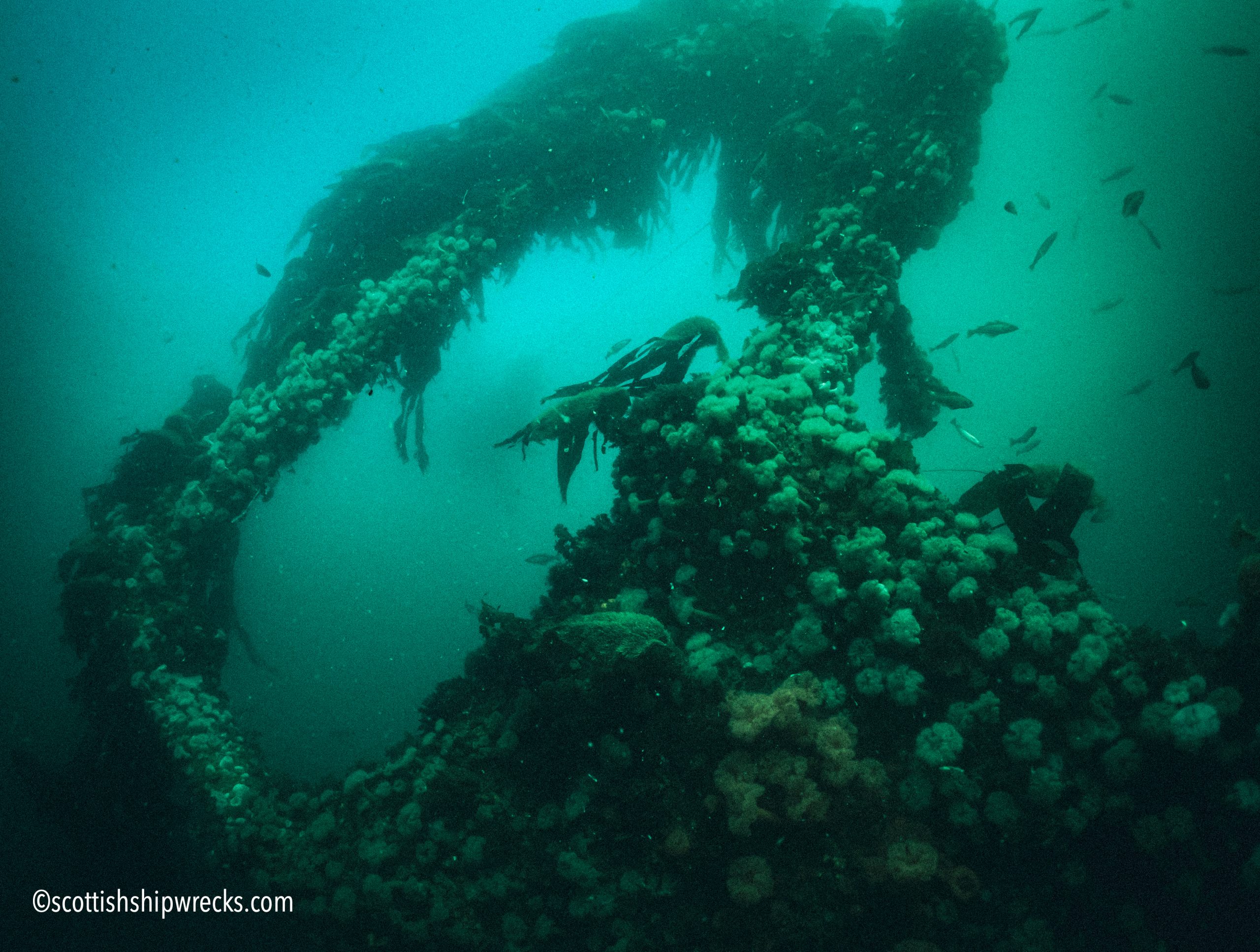
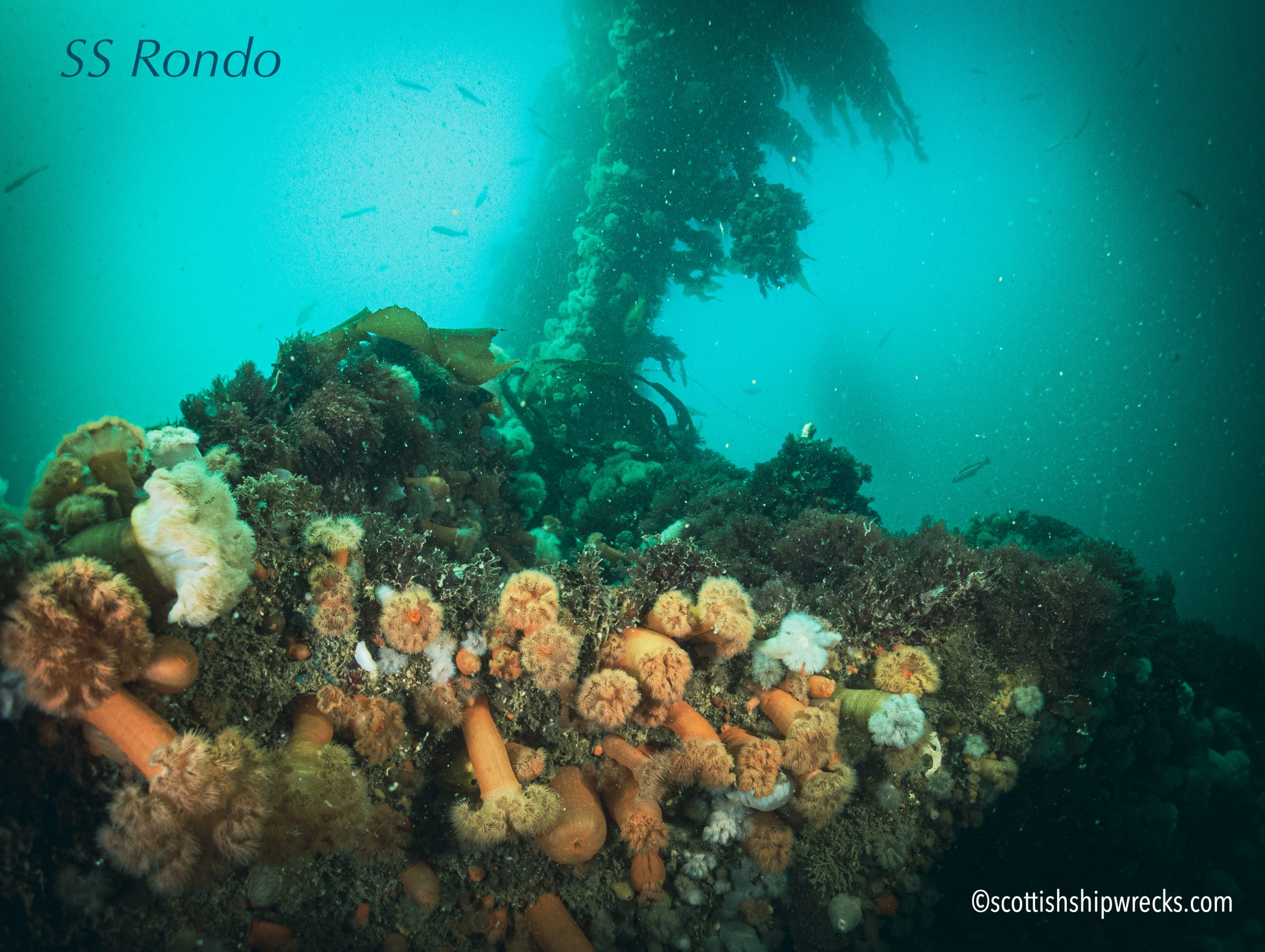
The steep rocky cliff down which the Rondo plunged makes this one of the area’s most dramatic wrecks. She sits almost vertical, on her bow which crashed into the seabed 50 metres below the surface, while her rudder post, is often visible from the boat only a few metres below the surface. She lies in position 56°32.306’N, 005°54.749’W (GPS) very close to the north shore of Dearg Sgeir. The hull is all that remains lying against the steep rocky cliff but the metal of the ship is completely covered in a colourful mass of orange, white and green plumose anemones and dead men fingers plus a multitude of other encrusting sealife. The wreck is always patrolled by shoals of curious wrasse and huge saithe and pollock making it more like a dive on a tropical reef than on a Scottish wreck.

The wreck itself is only a shell but the diver can swim down inside the hull emerging to more broken wreckage beyond 30 metres and down into the gloom to the crushed bow at 50 metres. On the way back to the surface a swim outside and under the wreck shows the colourful sealife at its best.
Rondo dive slideshow


The site is swept by very strong currents making diving at slack water almost essential. Inside the wreck the diver is sheltered from the current but can be easily swept way if great care is not taken when emerging from the wreckage, either to head for the surface or to explore the outside of the wreck.