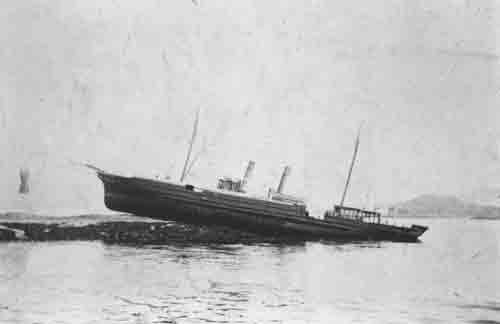
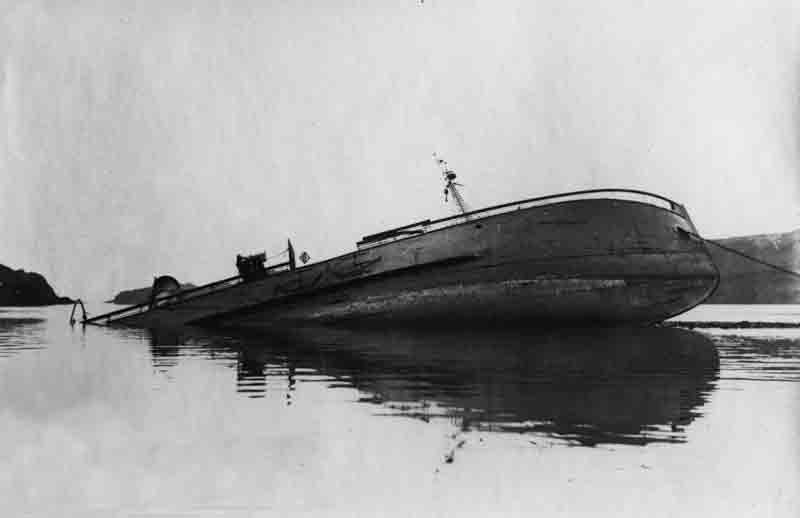
The steel steamship Kilsyth was launched from the Stockton-on-Tees yard of Craig Taylor (Yard No 96) on 10th August 1903. She had been ordered by the Kilsyth Steam Shipping Company of Newcastle. She measured 306.0′ x 43.9′ x 20.0′ and her tonnage was 2340 gross tons, 1498 net tons. She was powered by a triple expansion steam engine by North East Marine Ltd. Delivering 248 nominal horse power.

GA plans of vessel. Lloyd’s Register Foundation.
After four years of service she was sold to the Renfrewshire Steam Shipping Company of Glasgow before she was sold to her final owners, Alexander Brothers of Newcastle in 1917 who renamed her Burnstone. At the beginning of the war the Burnstone was fitted with a rear mounted gun for protection from enemy attacks.

Burnstone as SS Kilsyth under way
On 19th March 1918 she was outward bound from Immingham to Gothenburg with a cargo of coal when she was attacked by German U-boat UB-62 under the command of Oberleutnant Bernhard Pitzier which had sunk the steamship Oswin off Dundee a few weeks earlier. The U-boat fired a torpedo at the Burnstone without warning and watched as the ship began to settle by the stern before diving and racing from the scene to avoid the attentions of any British naval vessels in the vicinity. Five of the crew were killed in the attack. The remaining crewmen managed to launch a lifeboat and were picked up safely later.

Plaque to those lost – Tower Hill Memorial, London
The wreck of the Burnstone lies in position 56° 28.180’N, 01° 44.657’W in 52-53 metres of water with a least depth clearance of 43 metres and is oriented 005°/185°. The hull of the vessel is upright and fairly in tact with the bow standing proud of the seabed by 10 metres, the highest part of the wreck. The stern section is broken from the remainder of the wreck presumably due to the damage inflicted by the German torpedo. Midships, the engine is clearly visible and on the separated stern section the gun is also visible. The wreck was identified in 2009 when the bell, clearly marked Kilsyth, was recovered by divers.

Sketch of wreck on seabed (S Adams)
This sketch of the wreck provides further information on layout and condition, and will be very useful if you are planning a dive on the wreck. Note there maybe some deterioration to the wreck since this was produced. We would like to thank Stevie Adams for allowing us to reproduce his excellent sketch of the wreck of the Burnstone.

Bell recovered from wreck in 2009
We would like to thank Lloyd’s Register Foundation – Heritage & Education Centre for allowing us to reproduce documents from their archive in this article.