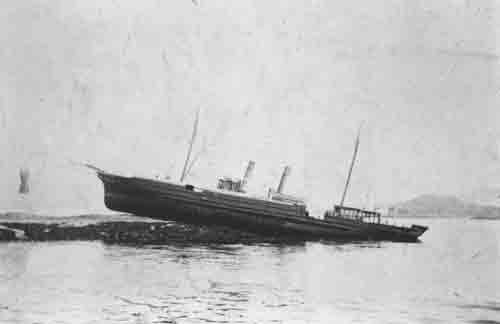
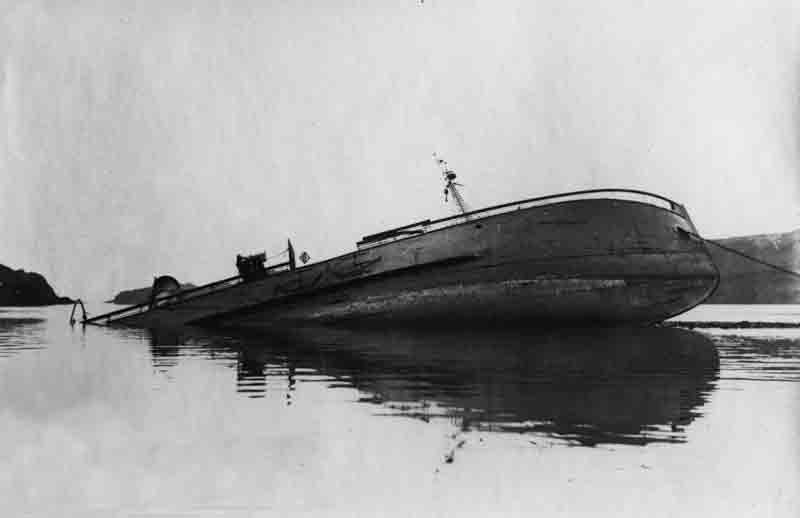
The steel steam trawler Dora was launched from the yard of F W Wencke in Bremerhaven in 1892. She measured 105.0′ x 21.0′ x 8.9′ and her tonnage was 134 gross tons, 58 net tons. She was powered by a 2 cylinder compound steam engine by R Kuchen, Bielefeldte, Germany delivering 70 registered horse power. Ordered by H Siebert of Bremerhaven she operated from this port until the outbreak of Word War One. On 30th September 1915 she was captured as a war prize by HMS Penelope and taken to Britain where she was fitted with a fitted with a 6″ deck gun and converted to wartime use in the British Navy. Coincidentally, on the same September day, another German trawler, Orion, was captured by HMS Cleopatra and converted to wartime use is the same way as Dora. The two German vessels were renamed Caersin and Cambersin as they entered service for the Royal Navy. At the end of the war Caersin was in Scapa Flow when the German High Seas was scuttled in June 1919. On completion of their war service the two vessels were purchased by Nicholas Cook of Aberdeen in 1920 and entered the Aberdeen fishing fleet. Caersin was registered in Aberdeen A427.

Lloyd’s register 1894 (Dora)
On 28th November 1926 the two vessels were fishing in the Moray Firth. The details of the incident are not recorded but, for some reason, Caersin and Cambersin collided in darkness seriously damaging Caersin in the process. Thankfully no-one was injured in the accident and Cambersin was able to take the disabled Caersin in tow and head back towards Aberdeen. The two vessels made good progress rounding Kinnaird Head and heading south towards Aberdeen. Unfortunately, when they were only a few miles from the entrance to the port, Caersin was settling deeper and deeper in the water and the crew were forced to abandon ship and board Cambersin. Caersin finally sank beneath the surface in a position noted as 7 miles north east of Aberdeen.

Aberdeen P&J 30th November
The wreck believed to be Caersin was dived by Buchan Divers in June 2023 who discovered a small trawler upright and in tact with damage to her bow. While nothing was found to positively identify the wreck the configuration, typical of German built trawlers of the era, and position of the wreck, directly on the route from Rattray Head to Aberdeen harbour, make it almost certain that this is Caersin. The wreck, which is oriented 025/205 degrees, lies in position 57° 16.591’N, 01° 54.121’W in 37 metres with a least depth clearance of 35 metres.