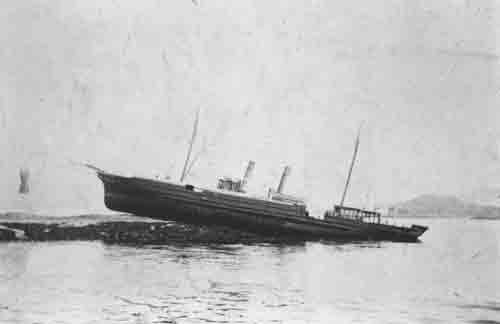
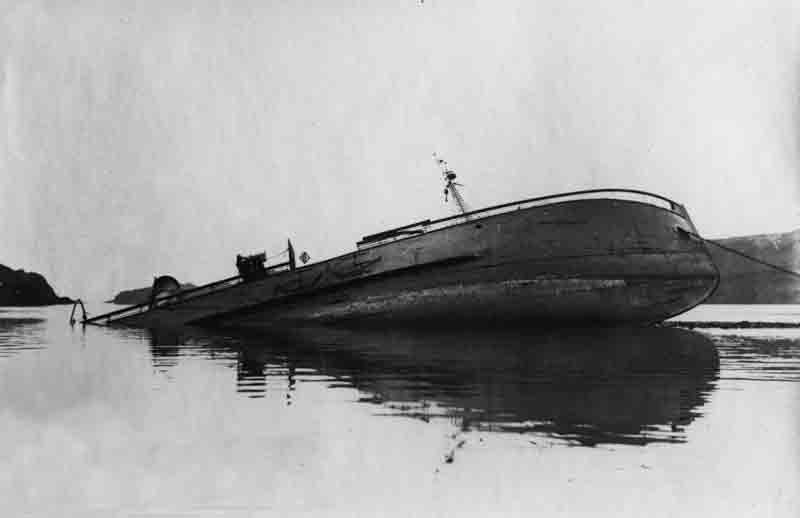
Launched from the Govan yard of Mackie and Thomson (Yard No 240) on 14th December 1899 the steel steamship Canganian measured 225.0′ x 34.0′ x 14.4′ and her tonnage was 1143 gross tons, 706 net tons. She was powered by a triple expansion steam engine by Ross and Duncan, Glasgow delivering 122 nominal horse power. Her official number was 109794.

Builders GA drawing – Lloyd’s Register
She operated successfully for her Welsh owners, O and W Williams of the Canganian Steamship Co Ltd, in the waters around the UK until the outbreak of World War One. She was requisitioned by the Admiralty for service as a fleet collier mainly shuttling back and forth between the coal mining ports of the east coast and the main Royal Navy bases of Scapa, Cromarty and the Forth.

SS Seagull – sister ship, same builder, specification and year Yard No 239.
On 17th November 1916 she was en route on one of her usual trips from Methil to Scapa with a full load of coal under the command of Captain Evan Henry Williams with a crew of seventeen men aboard. There was a strong SSE wind blowing making the sea rough and the sky was dark, hazy and gloomy. Without warning there was a huge explosion causing the hull to rear out of the water and within a minute the Canganian had sunk with the loss of all hands. The captain of the steamship St Rogvald described the events later.
“The vessel was about seven miles distant from us. Nothing unusual with the ship was observed until suddenly a large black cloud of smoke was seen and simultaneously one end of the ship rose right out of the water. She remained in her horizontal position for a few seconds then went down in less than a minute.” They raced to the scene as fast as they could but it was 45 minutes before they reached the position where the Canganian had sunk and by then all that could be seen was a single floating box.
The Canganian had struck a German mine laid by UC-29 under the command of Oberleutnant Ernst Rosenow on 1st November.

Canganian hit mine in barrage 15
The wreck believed to be the Canganian lies in position 56° 35.320’N, 002° 21.615’W oriented 130/310 degrees. She sits upright and mainly in tact in 60 metres with a least depth clearance of 53 metres.

Tower Hill Memorial
We would like to thank Lloyd’s Register Foundation – Heritage & Education Centre for allowing us to reproduce documents from their archive in this article.