The steel steam trawler Carmania was launched from the Grimsby yard of Charlton and Doughty Ltd (Yard No 41) on 29th April 1907. She measured 130.3′ x 22.0′ x 11.5′ and her tonnage was 250 gross tons, 107 net tons. She was powered by a triple expansion steam engine by Great Central Co-operative Engineering & Ship Repairing Co. Ltd. delivering 76 nominal horse power. She was built for the Grimsby Alliance Steam Fishing Co Ltd and registered in Grimsby (GY268) on 10th July 1907. Her official number was 125063. In 1915, now renamed Carmania II, she was requisitioned by the Admiralty for war service. At the end of the war she was sold to the Strand Steam Fishing Co Ltd of Grimsby and she continued to operate from the north east fishing port. In 1928 she was sold again, this time to Mr Thomas Baskcomb of Grimsby. She was not to operate for her new owner for long.

Carmania profile plan

Lloyd’s register 1908
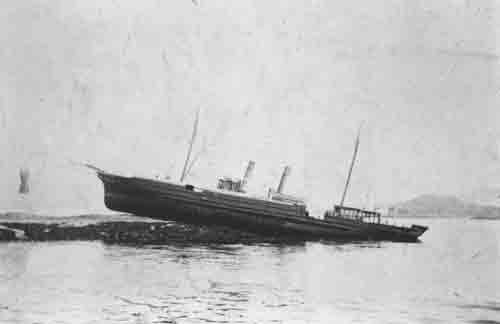
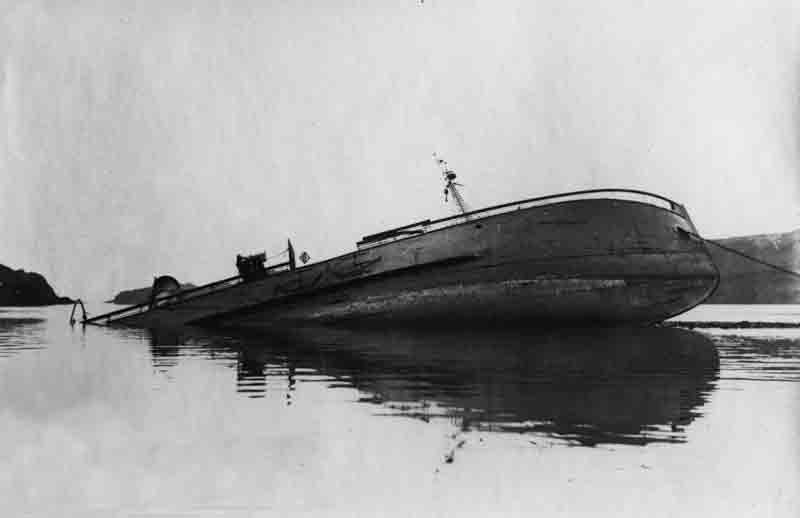
On 14th February 1929 Carmania II was returning to her home port from a successful trip to the Icelandic fishing grounds under the command of her skipper, J W Loftus, who had a crew of eleven men aboard. As the steamed down the west coastline of Orkney the crew were tired after a long trip and were heading into Stromness for a stopover and some much needed rest. As they turned into the entrance to Scapa Flow at Hoy Sound the vessel’s steering jammed – the Carmania was in trouble. In a strong ebb tide and heavy snow Loftus had no control of his vessel when a heavy sea hot the Carmania and swept her onto the treacherous reefs at Kirk Rocks. These rocks have been the graveyard of at least a dozen ships over the years. She was left in a very treacherous position too far from the shore for the local rocket team to reach them and too far, at least initially for the lifeboat that raced to the scene to reach the men as huge waves battered the vessel.

Carmania II stranded on Kirk Rocks
The lifeboat magazine excerpt below summarises the courage and skill of the lifeboat crew and coxswain that eventually rescued twelve fishermen.
“About 4 on the morning of the 14th February three messengers from different houses in Invertown brought the Honorary Secretary the news that a steamer, which was found afterwards to be the trawler Carmania II., of Grimsby, had gone ashore on the Kirk Rocks, Hoy Sound, and was showing signals of distress. The Coxswain and crew were called out immediately, and the lifeboat, which had not been housed after a service carried out three days before, owing to the stormy weather, left the harbour at 4.35. A strong breeze was blowing from the S.W., with a very heavy sea running, and the weather was bitterly cold. When the call came soft, blinding snow was falling. This ceased about the time when the lifeboat put out. She reached the neighbourhood of the rocks about five o’clock, and the lifesaving apparatus arrived at the same time, but neither could give the trawler any immediate help. She was too far from the shore for it to be possible for the apparatus to get a line to her, and too far in for it to be possible for the lifeboat to get near in the darkness and the breaking seas. There was no hope of approaching her from seaward, as the seas were breaking 100 to 150 yards before they reached her, while between the wreck and the shore were reefs and shallow water, where the lifeboat could not go until the tide rose.
The Coxswain waited.
By this time the trawler was lying with a very heavy list, and was rolling heavily. About an hour after the lifeboat arrived a huge wave lifted her as if she had been a cork, swung her completely round, and threw her right on top of the reef. Her lights were then burning, but gradually grew dimmer and eventually went out. About this time the tide turned and the seas grew heavier and heavier. The Coxswain stood by for another two hours and then decided to attempt a rescue. He manoeuvred the lifeboat through the breakers, and dropped anchor. The first attempt to establish communication by means of the line throwing gun failed, but the second and third shots succeeded, and two lines were secured on board the trawler. A lifebuoy was then sent to the wreck, and the lifeboat herself was veered in through the surf, nearer and nearer as the tide rose. She was thrown high in the air by every sea and then disappeared in the trough, but, watching for their opportunity when a lull came in the breaking seas, the lifeboatmen got the trawler’s crew off, man by man, until five were safely on board the lifeboat. All had gone well up to this point, but then a tremendous wave caught the lifeboat nearly broadside on, the wire cable snapped and the boat reeled to leeward. She was in imminent danger herself, but the Coxswain showed perfect judgment and seamanship and rushed the boat ahead among the reefs and breakers until he was under the lee of the wreck, with which he was still in communication by the ropes. Just before this happened the trawler’s small boat had been swept overboard and was floating under her lee. The Coxswain shouted to the men who were still on board to get into the small boat and he would haul them to the lifeboat. This was done, and five more men of the trawler’s crew were rescued. Then the painter parted, and the small boat was swept away with two men in her, but the lifeboat, passing again between the wreck and the shore, rescued the two men. Thus the whole of the trawler’s crew were saved. It was then nearly 9.30, five hours since the lifeboat had left harbour, and an hour and a half since the work of rescue had started”
We have no information on any subsequent salvage of the wreckage or if any remains of the Carmania still lie among Kirk Rocks. We have assigned a position of 58° 57.376’N, 03° 20.261’W to the wreck.