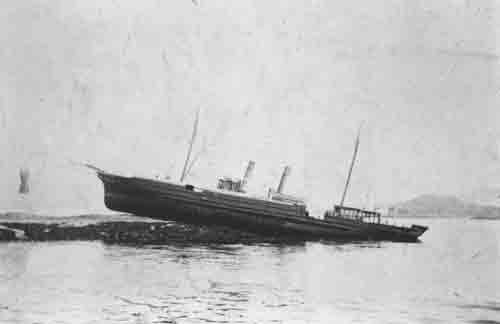
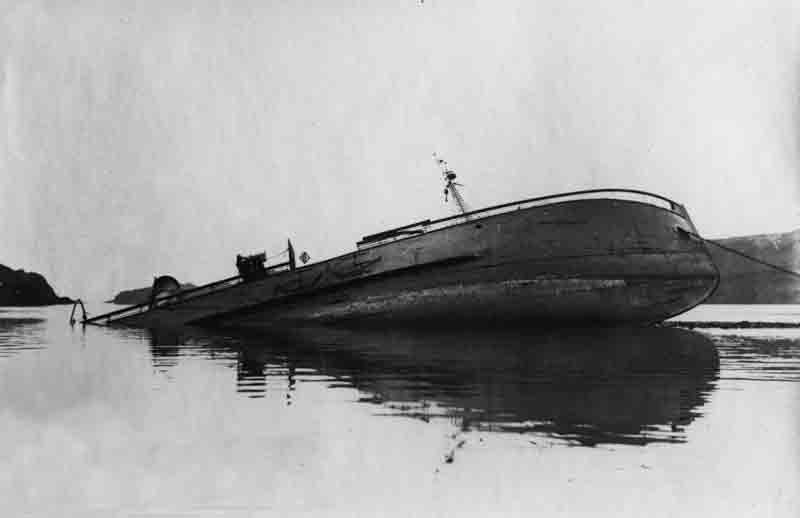
The cargo passenger steamship Saltees was built by D & W Henderson & Company of Glasgow (Yard No.322) and launched on 23rd September 1885 for the Clyde Shipping Company. The Saltees measured 186.0′ x 28.0′ x 14.2′ and her tonnage was 577 gross tons, 228 net tons. She was powered by a 2 cylinder compound steam engine delivering 119 nominal horse power also provided by her builders. The vessel’s official number was 90082.
The Saltees was purchased by the Ayr Steam Shipping Company in September 1892 and renamed Carrick. Under this ownership she was employed ferrying cargo and passengers between the ports of south west Scotland, north west England and Ireland.

SS Carrick dockside

Lloyds register 1906
In the early hours of the morning of 26th May, 1906 the Carrick was en-route from Belfast to Ayr with a cargo of cattle under the command of Captain Leadbetter with a crew of eleven and a total of six passengers. Around 1am they were close to Ailsa Craig when they were enveloped in a dense fog reducing visibility to around twenty yards. The captain posted additional lookouts and began sounding his steam whistle. Meanwhile, the SS Duke of Gordon reached the same area on her voyage from Greenock to Dublin with about fifty six passengers on board. She too was engulfed in the dense fog and Captain Reddin also posted forward lookouts.
On board the Carrick the crew strained nervously to see through the dark foggy night and seemed to be almost out of danger as dawn began to break when the bow lookout reported lights on the port bow immediately followed by lights dead ahead. The helmsman turned hard to port but it was too late. The bow of the Duke of Gordon tore into the starboard side of the Carrick near the fore rigging. The impact ripped a hole in the hull of the Carrick and rolled her over on her beam. The passengers below were plunged into a state of disarray and panic before the ship righted herself, allowing them to recover and make their way on deck. Two of the crew managed to jump onto the bow of the Duke of Gordon before the two ships drifted apart and lost sight of each other in the fog. Those remaining on board the Carrick quickly launched one of the lifeboats but, before they could all get aboard, she settled down and sank, taking the captain, who refused to leave the bridge, the cabin boy and four of the passengers with her.

The passengers and crew in the lifeboat were lucky to escape with their lives as first the suction of the sinking ship, then the panic stricken struggles of the unfortunate cattle fighting for their lives in the sea, threatened to capsize their boat. After rescuing two further exhausted passengers from the water they were picked up by the SS Mastiff which had, by now, arrived on the scene. The Duke of Gordon meanwhile, although damaged in the collision, searched the area for survivors but, after some time, gave up and resumed her voyage, safely reaching Dublin later in the day.

Board of trade inquiry summary 28 July 1906.
The intact wreck of the Carrick, lies in position 55° 06.996’N, 05° 10.705’W, and was positively identified after the recovery of her ship’s bell. The wreck, which sits upright in general depths of 45.5 metres rises on average 4-5 metres above seabed level.

Carrick bell recovered by divers
The bow, midships and stern are reasonably intact although the wreck has net across the focsle and part of the foredeck and another at the stern. The hull is beginning to collapse inwards in some areas. The engine and boiler sit midships and the bridge area has fallen into the forward hold area. The wreck lies approximately 040/220 degrees, with bow south west. The wreck sits on a soft mud seabed, and much of the wreckage is covered in a fine silt, so take care when finning. Visibility is generally 4-5 metres.
We would like to thanks Lloyd’s Register Foundation – Heritage & Education Centre for allowing us to reproduce documents from their archive in this article.