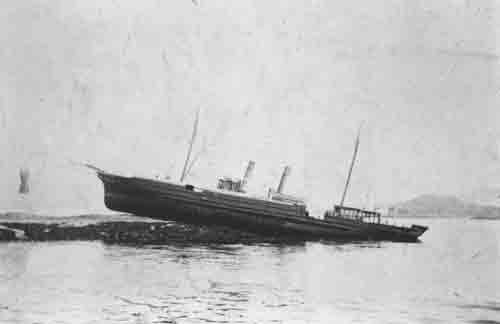
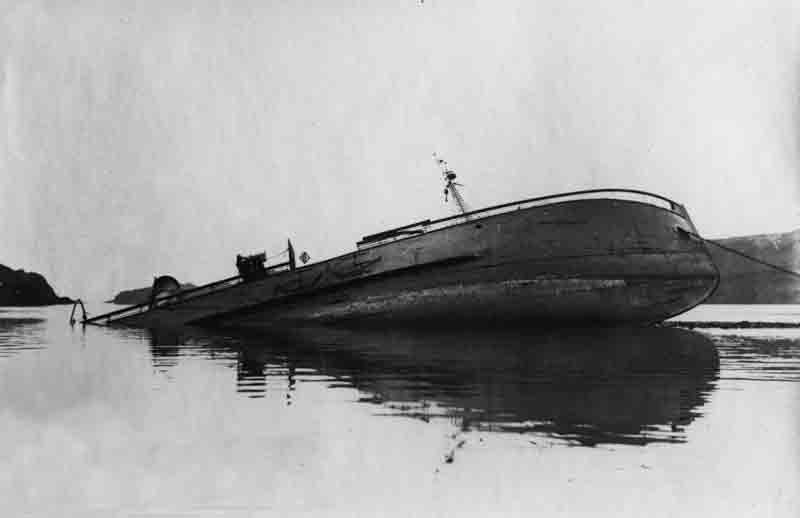
The wooden barque Excelsior was launched from the yard of Holens Verksted, Christiansand in 1869. Hall Russell and Co Ltd., Aberdeen (Yard No 500) on 19th October 1911. She measured 141.0′ x 30′ and her tonnage was 240 registered tons. . Ordered by Mr M Oppen, Larvik, Norway she operated on the North Sea coastal and Baltic Sea routes but at times also undertook longer voyages across the North Atlantic.

Contemporary painting of barque Excelsior (Norwegian Maritime Museum)
It was on one of these Atlantic voyages that she departed from Coosaw River, South Carolina on 8th September 1881 with a cargo of phosphate rock for Bo’Ness. She was under the command of Captain Christian Thomas Hansen-Goen with a crew of twelve men aboard. She reached the Orkneys on 6th October where she picked up a pilot at Longhope to assist in the vessel’s navigation down the east coast of Scotland. The voyage south went well until they encountered a severe storm off Kinnaird Head and were drive back to Orkney arriving there on 17th. Weeks later she headed south but, once more, south of Kinnaird Head on 21st November she ran into another storm. This time, in a severe SSW gale, she was not to escape and in the early hours of the following morning, on a pitch a dark night, she ran ashore south of Rattray Head despite desperate attempts to sail her offshore as they could see the huge white breakers in the darkness. It appears that the captain and pilot had miscalculated their position due to wind and strong currents and were west of their intended route.
When the vessel struck the captain immediately ordered the mast cut away reducing the risk of her breaking up quickly in the pounding surf. The crew were still in severe peril but help was quickly on hand. The coastguards from Rattray arrived at the scene but, unfortunately, the ship was stranded some distance from the shore and too far out for a line to be fired aboard. The lifeboat was also launched and reached the wreck site around noon but was unable to pull alongside the wreck in the massive swell. However, the crew succeeded in getting a line across to the wreck and finally the men, one by one, were pulled safely aboard. The Excelsior became a total wreck.

Scotsman 23rd November 1881
The wreckage believed to be the Excelsior lies in the intertidal area south of the lighthouse in position 57° 35.769’N, 001° 49.615’W and is visible a low tide. The extent of the visible wreckage varies as she is more or less covered or uncovered by the ever moving sands during stormy periods on this exposed coast.