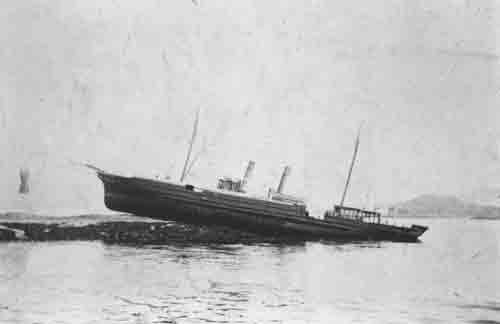
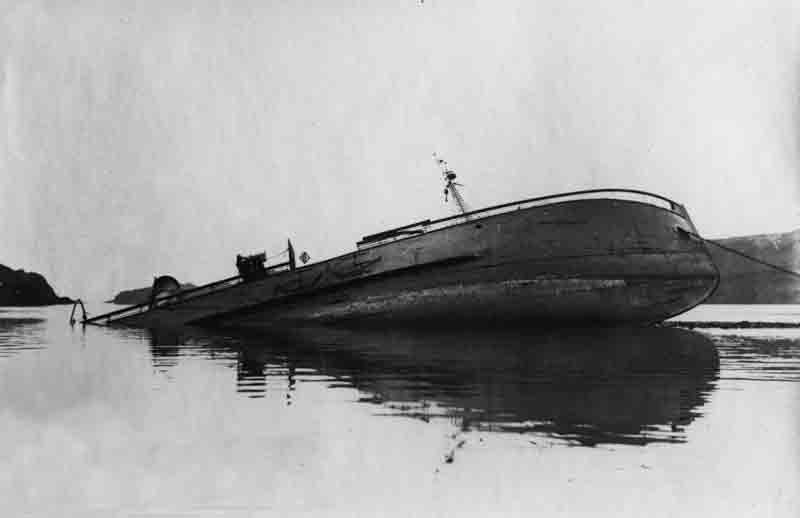
The steel stemship Type EC2-S-C1 Liberty ship Frederick Bartholdi was laid down at the J A Jones Construction Corporation Ltd., Brunswick, Georgia (Hull No 1503) on 29th August 1943. The ship was named after Frederic Bartholdi, the famous French designer of the Statue of Liberty. She was ordered by the US Department of Transportation under the Maritime Commission Contract process which was used to assemble a large fleet of low cost simple cargo ships to ferry supplies across the Atlantic. By the end of 1944 the United States War Shipping Administration had close to 3800 ships under their control.

Extract Lloyd’s Register 1943.
The build of these vessels was extremely fast and the Frederick Bartholdi was launched on 9th November 1943. She was one of 62 similar vessels launched from Jones’s yard between August 1942 and October 1944. She measured 422.8′ x 57.0′ x 34.8′ and her tonnage was 7176 gross tons, 4380 net tons. She was powered by a triple expansion steam engine by General Machinery Corporation, Hamilton, Ohio delivering 2500 horse power. The final build cost of the Frederick Bartholdi was $1,655,794.00

SS Frederick Bartholdi in convoy 3rd December 1943.
Allocated to the West India Steamship Company immediately after her launch, she was rushed into service that same month and loaded a general cargo in Jacksonville, Florida destined for London before proceeding to New York to join up with a large Transatlantic convoy. In addition to her crew of sixty three she had twelve passengers on board.
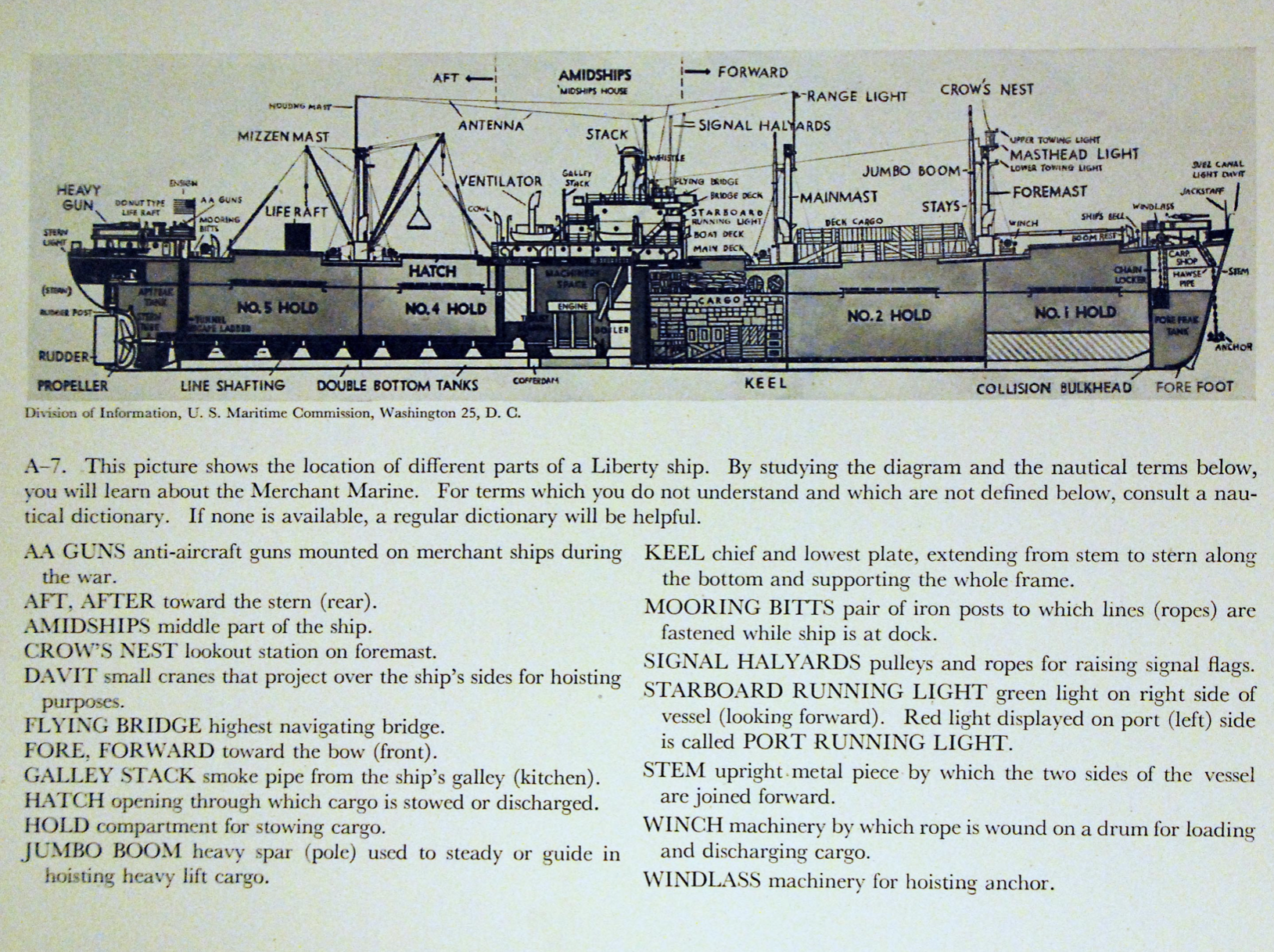
Diagram of layout and features of a Liberty ship
The convoy, HX270, consisting of sixty nine merchant ships and nineteen escort ships departed from New York on 10th December 1943. The convoy made it safely across the Atlantic and dispersed in the Western Approaches with the Frederick Bartholdi heading north, through the Minch, intending to take the route round Scotland to avoid the German U-boats laying in wait in the English Channel. As she made her way through the Minch she encountered heavy fog as she approached Skye on Christmas Day and ran aground on the north end of Fladda Chuain, a rocky island lying a few miles off the north west coast of Skye, in approximate position 57° 44’N, 06° 26’W.

Her distress messages were picked up by the Coastguard and relayed to The Stornoway Lifeboat Station who quickly launched the lifeboat William and Harriot and headed across the Minch in a south west gale to the scene of the wreck. When they arrived the ship was hard aground and being pounded by large waves which were breaking over the huge ship. She pulled alongside the wreck but understandably the crew were reluctant to descend the ladder they had lowered forcing the lifeboat to withdraw and stand by. Before long a number of HM trawlers arrived on the scene and landed a team of men who succeeded in getting a line onto the stranded ship. Most of the crew landed leaving five men aboard with the hope that she could be refloated and saved. Despite breaking her back in the storm the salvage team eventually succeeded in refloating her but the damage to the rapidly constructed vessel was substantial and she was declared a constructive total loss. It seems likely that much of her cargo was recovered before she was pulled off the rocks but we have no details of this. In June 1944 she is reported afloat in Uig Bay, and in July 1944 she is under tow to the Clyde taken to Kames Bay on Bute where she was dismantled by W.H. Arnott Young between September 1944 and March 1945.