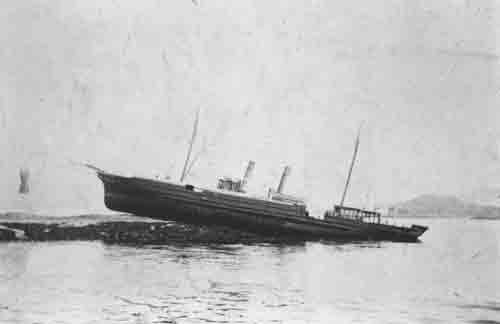
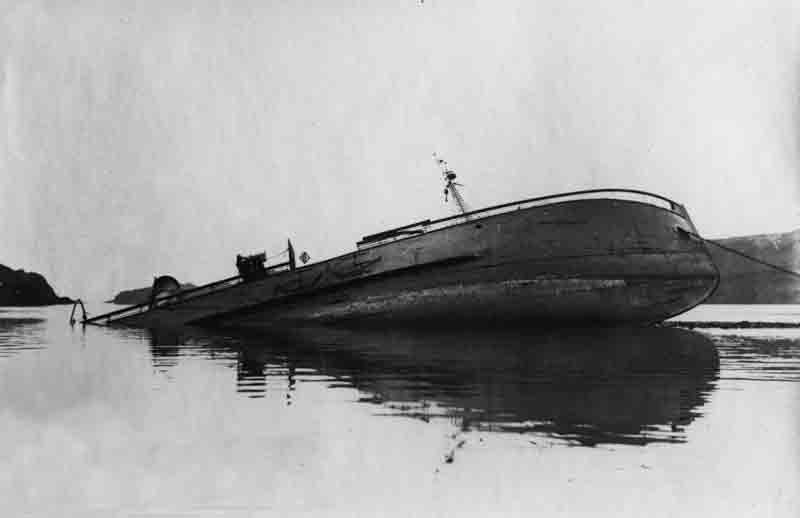
The steel Alarm class torpedo gunboat HMS Jason was launched from the Naval Construction & Armament Co Ltd., Barrow (Yard No 198) on 14th May 1892. She measured 242.0′ x 27.0′ x 12.5′ and her tonnage was 810 displacement tons. She was powered by 2 x 3 cylinder vertical triple expansion steam engines by Naval Construction & Armament delivering 3500 indicated horse power. In September 1902 new engines were installed by Fairfield Shipbuilding Co Ltd., Glasgow increasing her power to 5800 indicated horse power. She was armed with 1 x fixed bow 14” torpedo tube, 2 x revolving 14” torpedo tubes, 2 x 14” fixed torpedo tubes, 2 x 4.7” guns, 4 x 3 pounder guns and 1 Gardner machine gun.

HMS Jason
After her 1902 refit she joined the Nore Destroyer Flotilla of the Home Fleet and remained on this assignment until the outbreak of Word War One. In 1909 she was converted for use as a minesweeper. At the start of the war she was assigned to the Grand Fleet based in Scapa Flow and served during the early years of the war clearing mines in and around Orkney and the Pentland Firth.

HMS Jason
As the war proceeded into 1917 the key strategic convoy assembly point in the Firth of Lorne near Oban, where vessels and convoys crossing back and forth across the North Atlantic often made their first landfall in Britain, became an ever increasing target for German air attacks and mine laying operations. The German U-boat U-78 under the command of Kapitanlieutnant Otto Droscher had made an earlier trip to the area in summer 1916 laying mines near Skerryvore but in February 1917 that year she made a return visit and laid a number strings of mines in the area.

Mine barrages laid by U-78 in February 1917.
The U-boat laid six mines off Loch Don, Mull, eight mines off The Garvellachs on the 11th February (which were to cause the loss of SS Meldon in March 1917) and then six mines off the north entrance to the Sound of Mull and, most critically for this story, eight mines off Arinagour, Coll on the 12th February.

The Jason triggered a mine in Barrage 11.
Meanwhile HMS Jason had been assigned to the area to respond to the increasing efforts of the German mine laying U-boats clearing the critically important routes in and out of Oban for the incoming and outgoing convoys. It was on this duty, on the 3rd April, 1917 she was off the east coast of Coll in April of 1917 accompanied by HMS Circe.
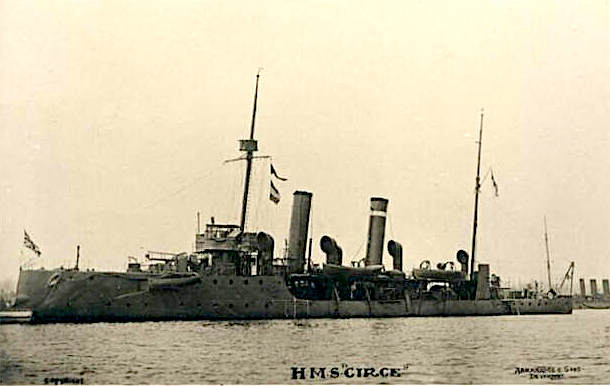
During minesweeping operations she was tragically lost when she struck one of the mines laid by U-78 and sank quickly with the loss of twenty five of her official complement of eighty five men. Crew members aboard Circe reported a huge explosion with Jason sinking after only a few minutes. Survivors reported being able to see the houses in Arinagour as they struggled in the water to be picked up by Circe.

Jason sinks bow first off the village of Arinagour, Coll.
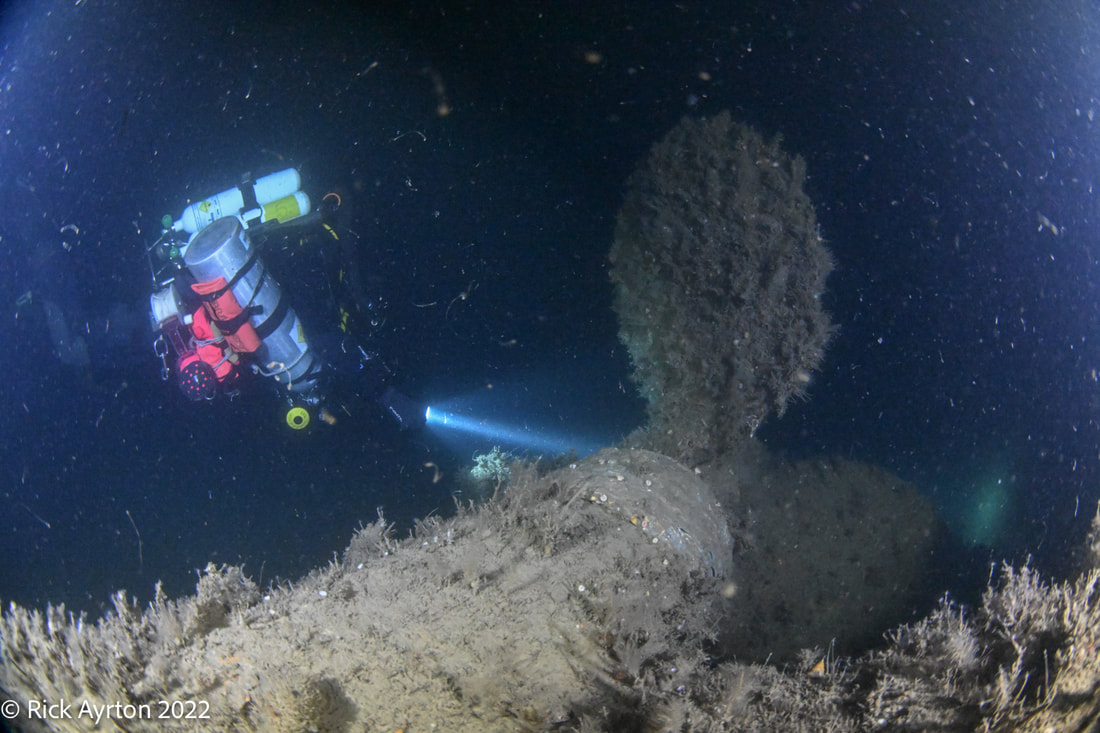
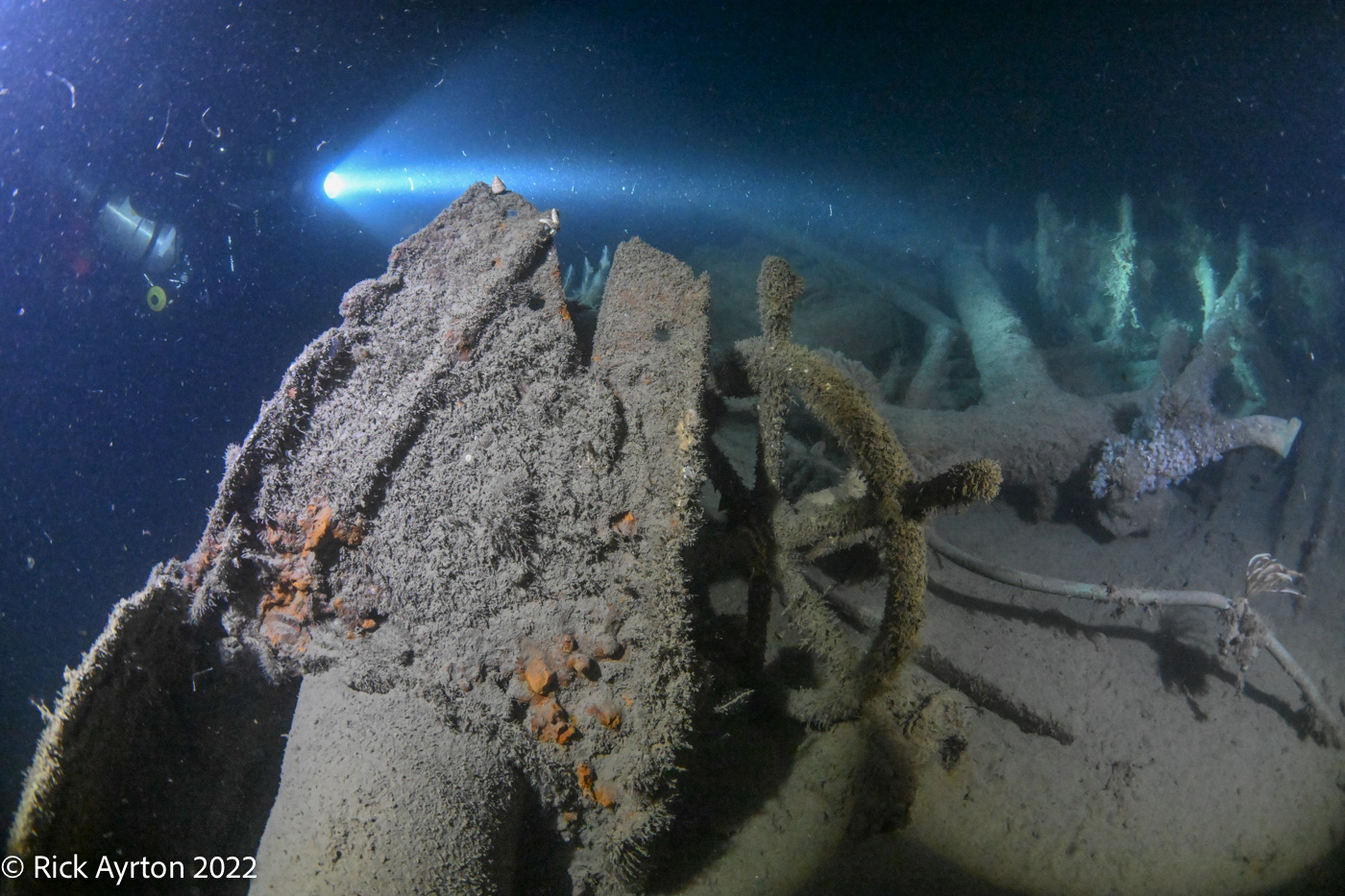
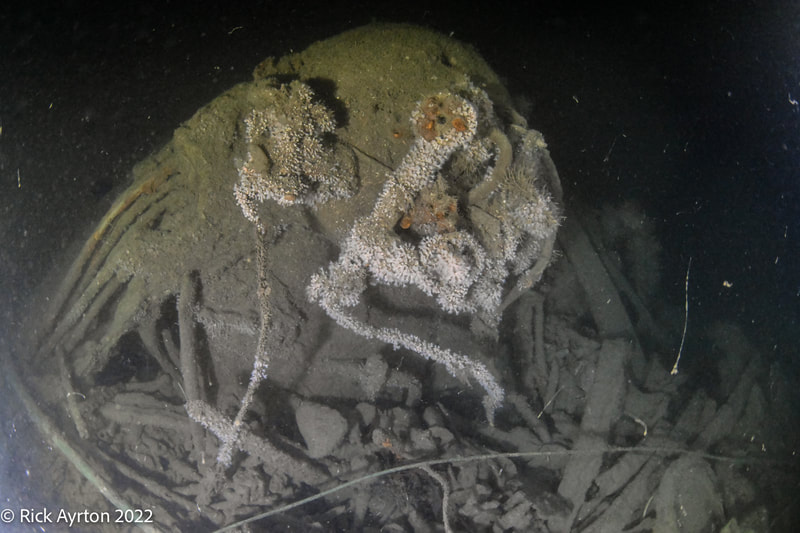
In Admiralty charts published in the 1930’s there was a wreck charted at 56° 36. 670’N, 06° 27.330’W but this mark disappeared from more modern charts and the wreck remained undiscovered until, after a number of fruitless searches in previous years, the wreck was finally revealed in 2021 during a search by Kevin Heath of Sula Diving, Orkney. In 2022 after further surveys a dive team aboard MV Clasina finally dived the wreck and confirmed it was indeed Jason. The seabed close to the east coast of Coll, off Arinagour drops quickly to depths of over 100 metres. The Jason lies in 93 metres and is well broken. The exact position of the wreck, clearly a war grave, has not been released. For the purposes on this record we have estimated a position of 56° 36.564’N, 06° 29.352’W.
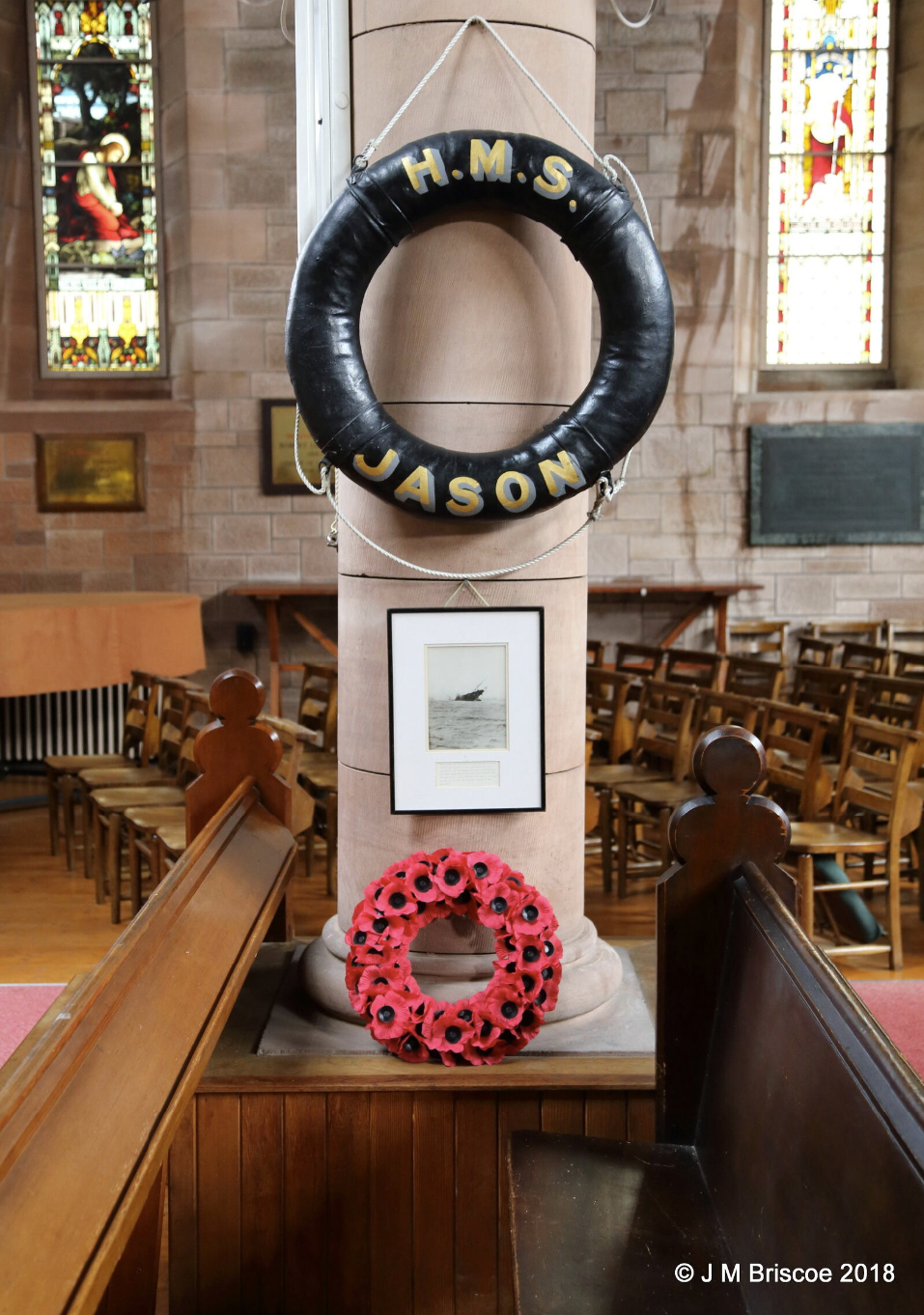
Memorial to those lost on HMS Jason, St John’s Episcopal Cathedral, Oban. Photo Martin Briscoe (WMR-44641).
We would like to acknowledge the assistance of the website – Lost in Waters Deep – in the preparation of this article. Link to website – www.lostinwatersdeep.co.uk