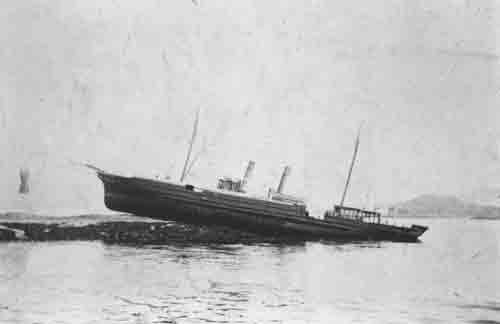
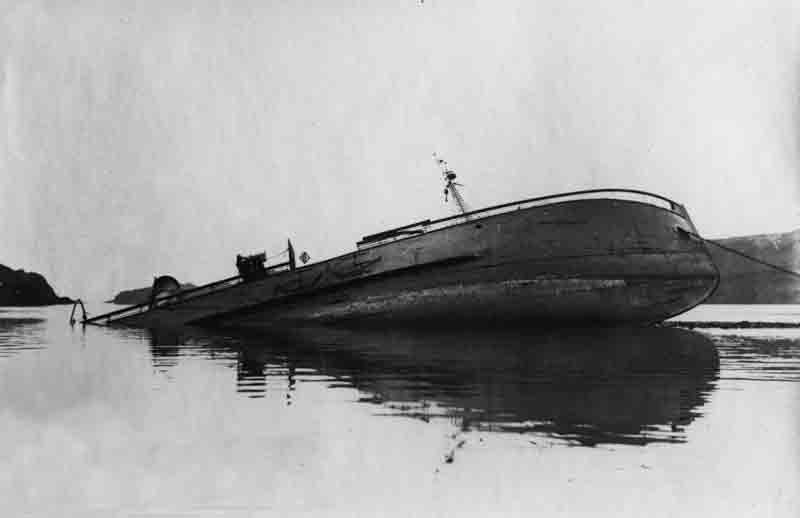
The steel steamship Langfond was launched from the Sunderland yard of Swan, Hunter Wigham Richardson on 2nd February 1920. She measured 285,6′ x 41,5; x 19.9′ and her tonnage was 2190 gross tons, 1266 net tons. She was powered by a triple expansion steam engine by Swan Hunter delivering 210 registered horse power. Her official number was 145481. Built for Svithun-Linjen A/S( Sigv. Bergesen) Stavanger she only operated fro this company for two years before she was sold to the Seed Shipping Co Ltd in March 1922 who renamed her Phyllis Seed. However this ownership only lasted 6 months before she was sold on again to Charbonnier Maritime Ste. Anne ( Schellens Shipping & Agency Co St.Anne) Antwerp, who renamed her Van Dyck. In 1925 she was sold again, this time to D.A. Cormack & Co., Leith who named her Elphinston. Finally, she was bought by D/S Jutlandia A/S (J. Toft) Copenhagen who named her Inger Toft. In April 1940, while docked in Methil, she was requisitioned by the British Ministry of War Transport and began a successful wartime career transporting cargoes to and from the British Isles in multiple convoys, many across the Atlantic to the Canadian muster locations at Sydney and Halifax Nova Scotia. In total her name is recorded in 124 convoys between 1940 and 1945.

SS Inger Toft alongside

Lloyd’s register 1944
In January 1945 she set off on her latest voyage from Southend to Methil then on to Loch Ewe before she headed to Reykjavik, Iceland a couple of weeks later, her most frequent destination over the previous twelve months, accompanied by two other vessels. The short route between Scotland and Iceland was not targetted too strongly by the German U-boats as the traffic on the route was relatively light. Having delivered her cargo she was then loaded with a full cargo of herring meal and cod liver oil and set off on the return journey to Britain in convoy RU156 accompanied by four other vessels. They were initially bound for the convoy assembly point at Loch Ewe then onward bound to Southend. On 16th March the convoy dispersed off Loch Ewe and Inger Toft continued her journey south down the Scottish west coast.
Later that day when off Neist Point, Skye she was attacked by U-722 (Oberleutnant Hans Reimers). Remeirs had departed from the German U-boat base at Trondheim on 21st February and after crossing the North Sea and heading round the north of Scotland had begun his patrol in the waters of the Minch between the Scottish north west coast and the Outer Hebrides. The details of the attack are not recorded as U-722 herself was sunk only a few days later when she was depth charged by three British frigates HMS Fitzroy, HMS Byron, HMS Redmill with the loss of Remiers and his crew of 43 men. Inger Toft was torpedoed by U-722 on 16th March and sank quickly but thankfully her crew, Captain N Brinck and his 29 crewmen, were safely picked up by armed trawler HMS Grenadier.

Lloyd’s voyage card recording the loss
The wreck in position 57 25.362N, 06 50.736W has not been positively identified but her position a few miles from Neist Point and the wreck dimensions (77 x 14 x 12 metres) would strongly suggest this is the wreck of Inger Toft. She lies in 137 metres with a least depth of 124 metres oriented 005.185 degrees.