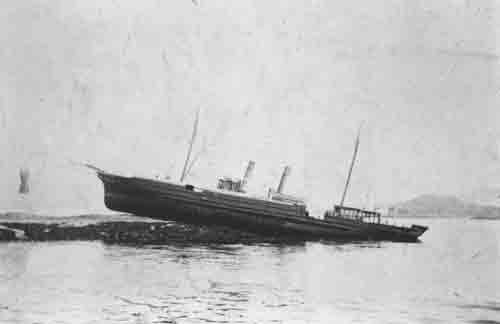
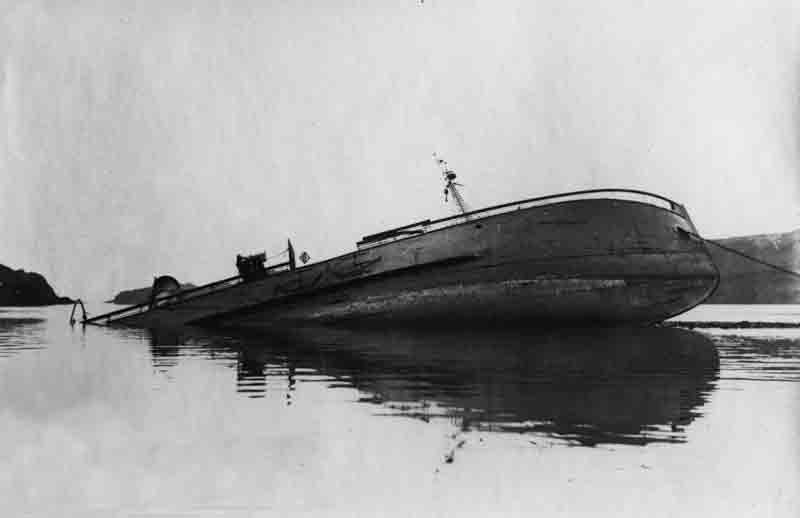
Built in William Pickersgill and Sons’ Sunderland yard the steamship Kildale was launched on 22nd February 1924 for her owners Rowland Marwood Steamship Company of Whitby. She measured 363.5′ x 51.4′ x 22.8′ and her tonnage was 3877 gross tons, 2310 net tons, She was powered by a triple expansion steam engine built by Richardsons, Westgarth and Company, West Hartlepool delivering 345 nominal horse power.

Steamship Kildale alongside

Lloyds register 1939
With the outbreak of World War Two in 1939 Britain’s merchant fleet became a vital lifeline ferrying supplies to and from the country’s allies in Europe and across the Atlantic. The Kildale was fitted with deck guns intended to provide some defence from U-boat and air attack. She was damaged in an air attack by a squadron of German Heinkel bombers off the Humber on 23rd February, 1940. 8 crewmen were killed but the ship was towed to the Humber by the tug Yorkshireman where she was repaired to re-enter service.

Steamship Kildale on fire off Hull.
In May 1940 she was assigned a dangerous trip from Southend to Brest in France with a cargo of coal returning to Liverpool with a cargo of iron ore on 26th June. Her next assignment was to take her across the Atlantic to join the hundreds of allied vessels steaming back and forth to bring supplies from North and South America.
Her final voyage began when she picked up a cargo of sugar in Barahona, Dominican Republic and headed north to the convoy rendezvous point off Sydney, Nova Scotia in September 1940. Her convoy, SC6, consisted of at least 39 merchant ships and 6 escort vessels heading east to various UK ports with the majority heading for Liverpool. The convoy set sail from Sydney on the 27th of September. Kildale’s final destination was London with a route planned to round the north of Scotland to avoid the dangerous waters west of Ireland and the gauntlet of the English Channel. The convoy lost four ships to U-boat attack en route across the North Atlantic but Kildale arrived safely in the Firth of Clyde on 12th October where the convoy dispersed. The next stage of her long journey was planned as part of the coastal convoy WN20. By the time the convoy left the Clyde on the 31st October 20 ships had been assembled escorted by two armed trawlers, HMT Pentland Firth and HMT Northern Spray. They were bound for Methil with passage through the Pentland Firth. The convoy would then disperse with the ships heading onward to various east coast ports of Britain.
On 3rd November, when approximately 7 miles off Rattray Head, the convoy was attacked by German bombers. In the attack they managed to damage the steamship Eros and fatally injure the Kildale. Two of Kildale’s crew, an able seaman and a steward, were lost, probably killed by the explosion as the bomb hit. The remaining crewmen abandoned ship in her lifeboats to be picked up by the convoy escorts before the ship finally sank.

Lloyds casualty report
The wreck lying in position 57°45.191’N, 01°46.031’W which rises 5 metres from the charted seabed depth of 64 metres was well known to local fishermen and dubbed Roulette Worker before she was dived and identified in 2005. The wreck itself lies on a fairly flat seabed oriented 010°/190°. Although nothing has so far been found on the wreck to positively confirm her identity the size, layout and position of the wreck make the identification almost certain. She sits upright and fairly in tact although the deck structures are well degraded. Two of the defensive guns fitted at the start of the war are clearly visible.
We would like to thank Lloyd’s Register Foundation – Heritage & Education Centre for allowing us to reproduce documents from their archive in this article.