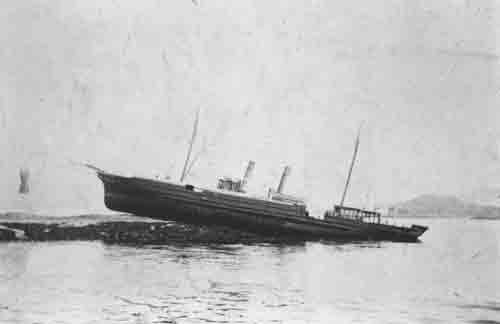
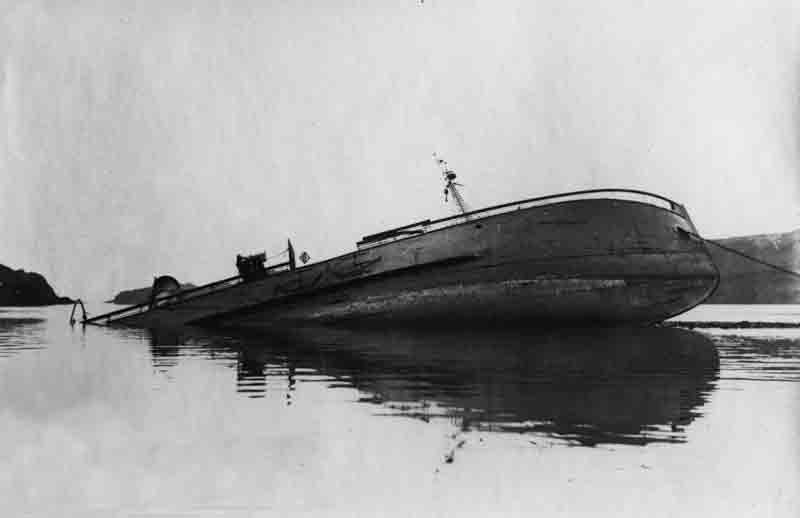
The steel motor vessel Mim was launched from the yard of Flensburger Schiffsbau Gesellschaft Flensburg (Yard no 441) in 1938. She measured 413.9′ x 56.1′ x 24.9′ and her tonnage was 4996 gross tons, 2966 net tons. She was powered by a 2S CDA diesel engine by MAN (Maschinenfabrik Augsburg-Nurnburg Augsburg) delivering 973 nominal horse power. She was ordered by Skibs Skytteren A/S (Yngvar Hvistendahl, Tonsberg) and commenced operations in the weeks before the outbreak of World War Two. With the outbreak of war all cargo ships crossing the North Sea became possible targets for the German U-boat fleet and marauding German aircraft patrolling from their bases in Northern Germany.

Mim under way

Lloyd’s register 1938
Mim’s maiden voyage took her to Fremantle, Western Australia where she was loaded with a full cargo wheat for Bergen. Captain Olaf Andreas Nielsen was in command and he had a crew of 30 seamen aboard. En route, Mim stopped off in South Africa for coal then proceeded to the Canary Islands where she was given authorisation for the remainder of her voyage. Nielsen was well aware of the dangers of the German U-boats and planned a route west of Ireland and Scotland then north to near the Faroe Islands before turning east and heading towards Norway. However, she was intercepted 60 miles NW of Faroe on October 31 by a Royal Navy ship HMS Colombo. Mim was boarded by Lt Commander, William K. Buckley, RNVR, who explained that an armed boarding party was to take over the ship and continue to Kirkwall for investigation. He left on board Sub Lt John A. T. Maisham, a navigation officer, and six naval ratings one of whom was a signalman.
The story is then based on reports from the islanders on North Ronaldsay who observed Mim heading south but too close to the islands. Despite warning blasts from the foghorn ashore Mim proceeded south closer and closer to the rocky shoreline. William Thomson, Receiver of Wrecks, was one of the many watchers who saw the Mim. As the ship passed Dennis Taing, sailing in a southerly direction. Thomson, in an account given to the district controller Coastguard some time later, remarked: “The Mim was lit up like a Christmas tree”, and, as he stood at his door he said to the womenfolk that if the vessel did not alter course she would find herself on the Reef Dyke a dangerous submerged reef about one mile south east of the island. Shortly afterwards, at exactly 10.10pm, Mim struck Reef Dyke.
At the time of grounding the wind was from the south-east, force four, increasing. The tide was flowing and would do so until around one in the morning. Ebb tide would follow and run strongly north over the reef for almost the duration of the prolonged rescue operation that ensued. Visibility was good with the moon giving a little light in a somewhat overcast sky. Principal lighthouse keeper, David Work, in his official account, noted that when the Mim came to a sudden stop she sent out an SOS a signal which she continued to transmit for some hours. A white flare was also fired. This was answered by flares fired from the lighthouse and the Start Lighthouse on Sanday. The Stromness Lifeboat, J J. K S. B., whose secretary at the station had been informed of the casualty, left Stromness at about 11 pm under Coxswain Greig on a 60 mile stormy trip round the west side of Orkney. She was to arrive at the casualty some seven hours later.
As weather conditions were deteriorating a local man, John Tulloch, North Ness, made the decision to attempt a rescue. He was in charge of the North Ronaldsay post boat which carried the Royal Mail and passengers to and from Sanday. His knowledge of the sea and reputation as a seaman was unquestionable. He launched the motor post boat from Nouster pier and embarked on their mission. The only lights available, either on the pier or in the post boat, were hand held flashlights. Having arrived at the Mim, 11 men were taken aboard the post boat and were landed at the pier, and shortly afterwards conducted to the Memorial Hall where the Shipwrecked Fishermen and Mariners’ Royal Benevolent Society attended to their needs. Tulloch and his crew set off again arriving at the Mim at 3.30am. However, this time fuel oil, which either had leaked or had been discharged from Mim, got into the boat’s water intake and stopped the engine. Sails were hoisted and with five naval ratings from the prize crew aboard Mim he set off for home arriving back at the jetty at 5am. The landing this time was difficult and dangerous with the southeast wind blowing from force five to six. With great skill, in darkness, with only the light from flashlights and without engine power, the boat was brought alongside the pier and the ratings were able to scramble ashore. About this time the lights of the Stromness Lifeboat were seen coming down the North Ronaldsay Firth, and the five ratings, who were met by the assistant lighthouse keeper, proceeded to the lighthouse where they were looked after. The Stromness Lifeboat arrived at the Mim at 7.30am and rescued the remaining survivors, which their records show to have been 22.

Wreck position
As for the Mim, on the next day the ship split apart with a loud explosion, due most likely to the expansion of thousands of tons of wet wheat. And within three days, exposed to the full fury of the sea, she had completely disappeared except for her funnel. Great quantities of wheat came ashore, along with all kinds of wreckage, and no doubt some houses will still have a memento or two of the Mim. Her remains lie scattered among the rocks and crevices that shear away in deep water behind the reef. There are reports that a bronze propeller was recovered at a later date but, although we have no reports of divers exploring the wreckage, it seems certain that some wreckage, perhaps substantial, will remain at the site in approximate position 59° 21.103’N, 02° 22.369’W.