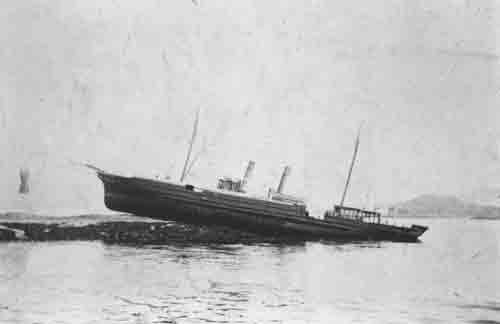
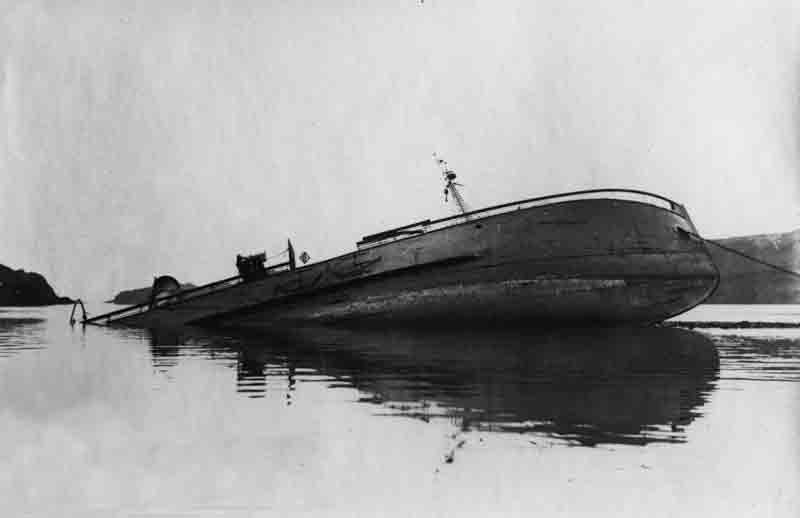
The steel general cargo steamship Moray Firth was launched from the Torry yard of John Lewis and Co Ltd (Yard No 106) Aberdeen on 8th November 1927. She measured 160.2′ x 26.6′ x 9.9′ and her tonnage was 541 gross tons, 255 net tons. She was powered by a triple expansion steam engine by her builders delivering 63 nominal horse power. She was built for the Firth Shipping Co Ltd (G T Gillie and Blair Ltd mgrs) and registered in Newcastle on 25th November 1927. With the outbreak of World War Two Moray Firth was employed on multiple coastal convoys between Southend and the Clyde in 1941 and then between Methil, Loch Ewe and Oban in 1942. On 7th December 1942 she was purchased by George and Andrew Grace of London.

Profile plan of SS Moray Firth

Lloyd’s register 1939
Due to wartime reporting restrictions the absolute details of her loss are not reported but, on 27th March 1943 she was en route from London to Kirkwall with a cargo of cement under the command of Captain Ernest Charles Roberts. As they reached a point later reported to be 4.5 miles north east of Portknockie she was run down by the George Couper and Co Ltd’s steamship Berriedale. Moray Firth sank quickly with the loss of ten crewmen. It is not clear from the contemporary records if there were any survivors.

SS Berriedale alongside
At a subsequent case in the Admiralty court Couper and Co were found to be liable for the loss of the Moray Firth and the cause of the collision was held to be entirely the fault of the captain of the Berriedale who had failed to navigate his vessel with due care. Coincidentally the Berriedale was lost herself in the Moray Firth area fourteen months later when she capsized in a storm off south east of Duncansby Head on 19th May 1943 on a voyage from Blyth to Stornoway with a cargo of coal.

Newspaper report on court finding
The wreck of the Moray Firth is not recorded on the Hydrographic charts of the area but the wreck has been dived and identified by the recovery of the ship’s bell. Local reports indicate that the wreck lies in position 57° 47.396’N 02° 47.139’W which would place the wreck in depths of approximately 60 metres.

Bell recovered from wreck
We’d like to acknowledge the contribution of Simon Cook providing the local details of the location of the wreck.