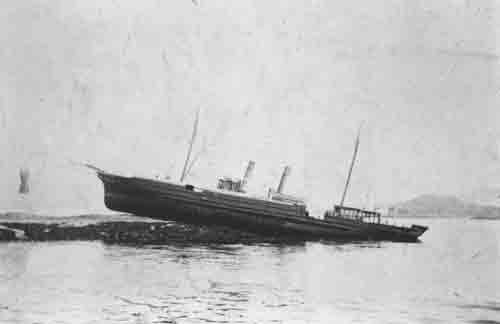
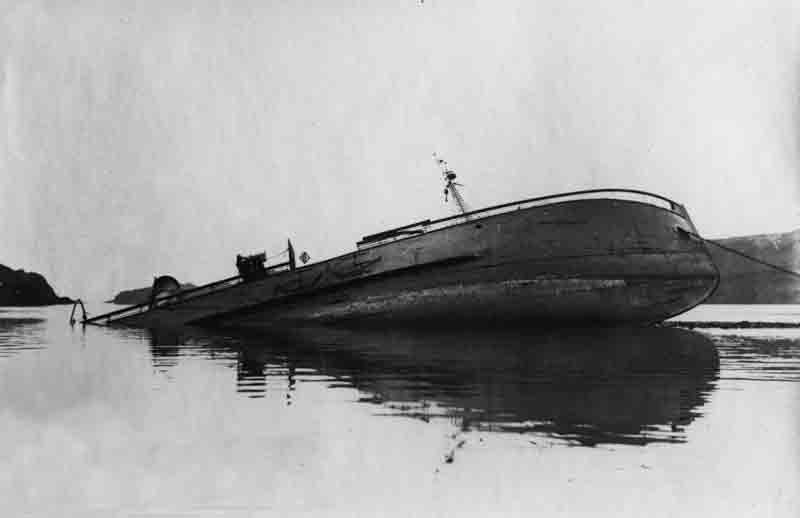
The steel steamship Prince Rupert City was launched from the Sunderland yard of William Gray and Co Ltd (Yard No 1019) on 10th July 1929. She measured 400.5′ x 54.3′ x 25.6′ and her tonnage was 4749 gross tons, 2882 net tons. She was powered by a triple expansion steam engine by Central Marine Works, West Hartlepool delivering 339 nominal horse power. Ordered by the Reardon Smith Line Ltd., Bideford she began service for this company late in 1929. With the outbreak of Word War Two this powerful fast cargo ship joined the huge fleet of vessels employed in bringing vital wartime supplies to Britain risking the attentions of the German U-boat fleet and the attacks of the Luftwaffe. At the outbreak of the war she was in the Philippines and initially crossed the Pacific where she was employed on various routes along the North and South American west coast. Finally she crossed the Atlantic in her first large convoy in December 1939 and thereafter began multiple Transatlantic voyages bringing cargoes into Liverpool. She made one long round trip to South Africa and Freetown in early 1941 before being redeployed on her normal Transatlantic duties between Liverpool and Halifax, Nova Scotia.

Prince Rupert City under way

Lloyds register 1939
On 28th April 1941 she arrived back in Britain in Convoy HX120 reaching Oban before heading north through the Pentland Firth arriving in Hull on 7th May. On 27th May she headed north again, in ballast, leaving Spurn Head on 27th May in coastal convoy EC25 before joining up with a further convoy EC26 in Kirkwall heading for the Clyde where she was to join a large convoy heading for Nova Scotia. Convoy EC26 consisted of 21 merchant ships and was due to arrive in the Clyde on 3rd June. However, on 31st May, while steaming east from the Pentland Firth, the convoy was attacked by German bombers. Prince Rupert City suffered a direct hit killing four of her crew. She remained afloat until the following day allowing time for the evacuation of the remaining 43 crew members and 2 passengers aboard before she foundered in a position reported to be 35 degrees 5 miles north east of Cape Wrath.
The wreck of the Prince Rupert City has not been positively identified as far as we know but the wreck lying in position 58° 46.0057′ N, 004° 47.089′ W oriented 117/297 degrees matches the position, dimensions and configuration Prince Rupert City and, as such, is almost certainly this vessel. The survey reports a large, in tact wreck lying on her starboard side in 78 metres with a least clearance of 71 metres.

Tower Hill Memorial