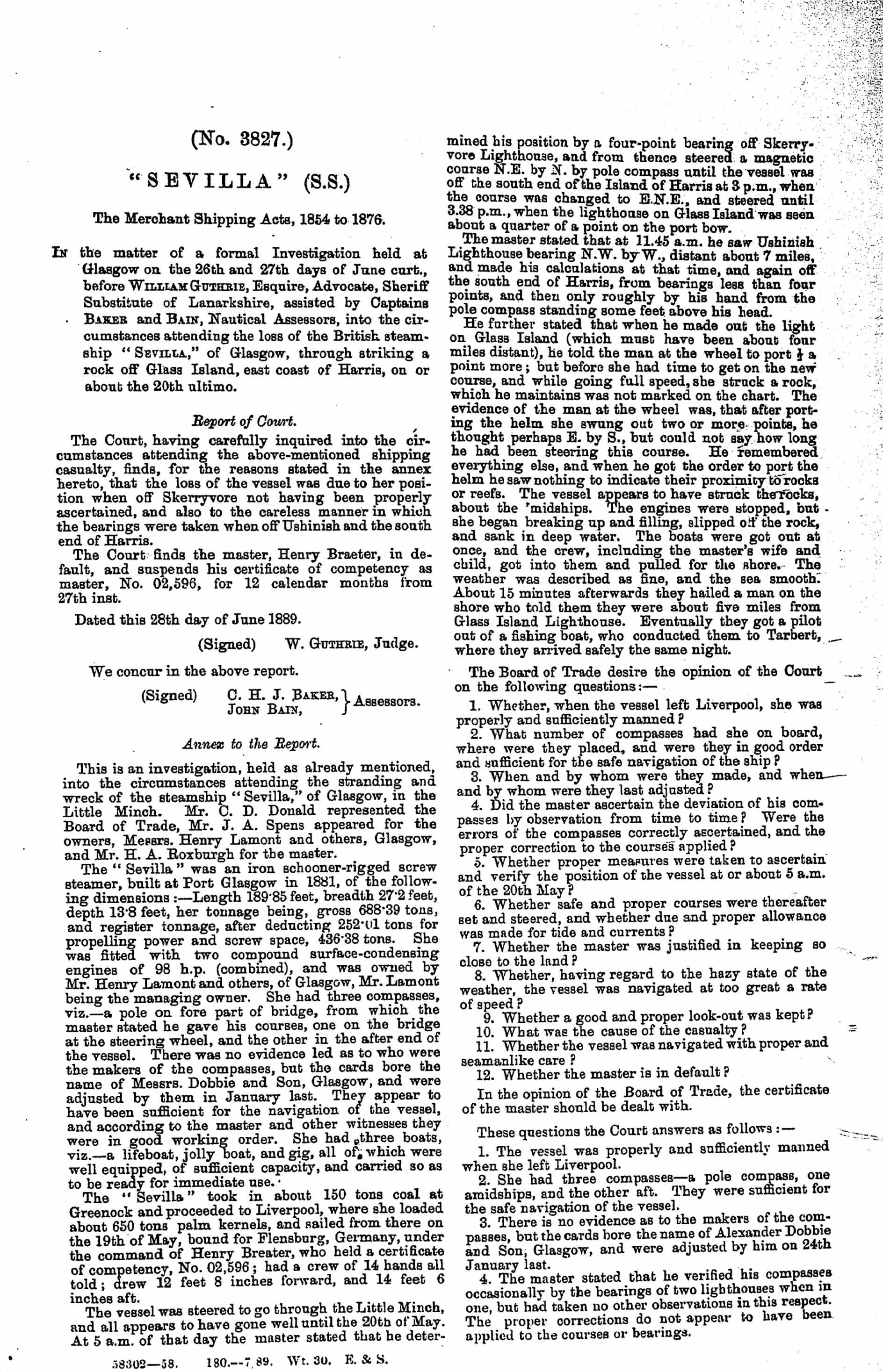
The iron steamship Sevilla was launched from the Port Glasgow yard of Henry Murray and Co Ltd (Yard No 109) on 10th November 1881. She measured 189.6′ x 27.2′ x 13.6′ and her tonnage was 688 gross tons, 436 net tons. She was powered by two compound surface-condensing steam engines by Hutson and Corbett, Glasgow delivering 98 nominal horse power. Built for Henry Lamont and Co Ltd., Glasgow she was registered in this city on 12th December that year.
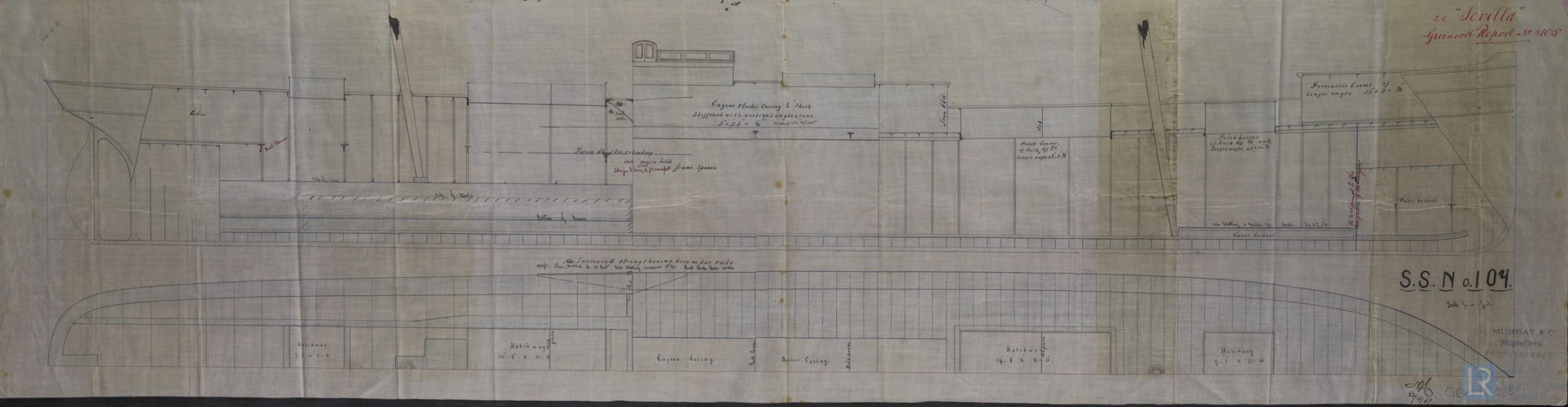
Sevilla profile plan

Lloyd’s register 1889
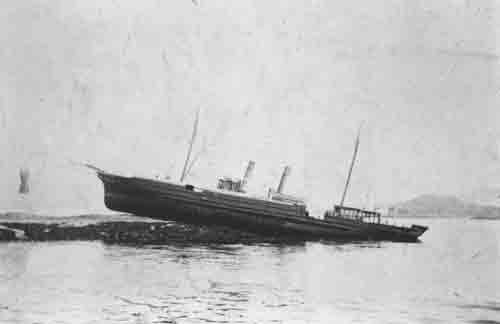
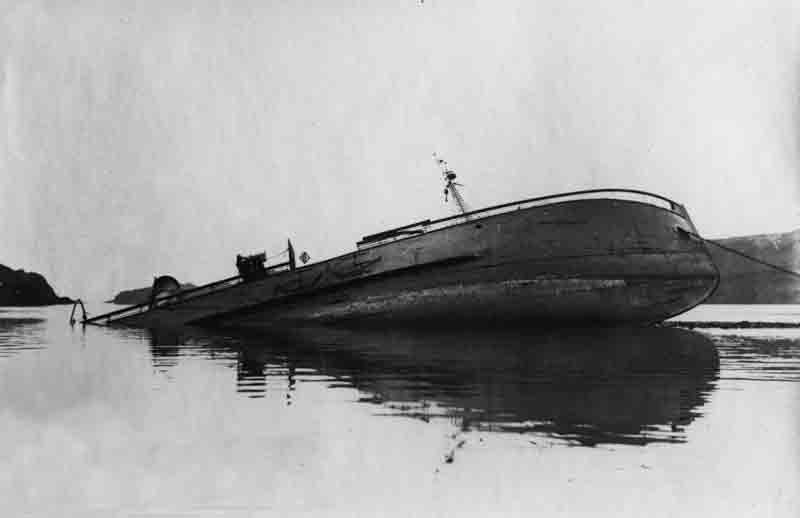
After loading a cargo of 650 tons of palm kernels she departed from Liverpool on 19th May 1889 under the command of Captain Henry Breater who had a crew of thirteen men and his wife and child aboard. She was destined for Flensburg, Germany steaming north through the Pentland Firth before crossing the North Sea. By 5am the following day they were off Skerryvore and Captain Breater set a course for the south end of Harris which they reached by 3pm. At 3:38 the lighthouse at Eilean Glas was off their port bow and the skipper ordered his latest small course adjustment in an easterly direction. Throughout the previous few hours the captain made a number of estimated position observations and slight course adjustments but, minutes after sighting the lighthouse on Eilean Glas Sevilla ran hard aground at full speed on Bogha Bhocaig (Poor Women’s Rock). The engines were stopped but, due to the nature of the reef, the vessel began to break apart almost immediately. Thankfully the weather was calm allowing the captain to order the boats launched and, with everyone safely aboard, they reached the shore nearby soon after where they were assisted by the local community. Sevilla later slipped off the rock and sank in deep water.
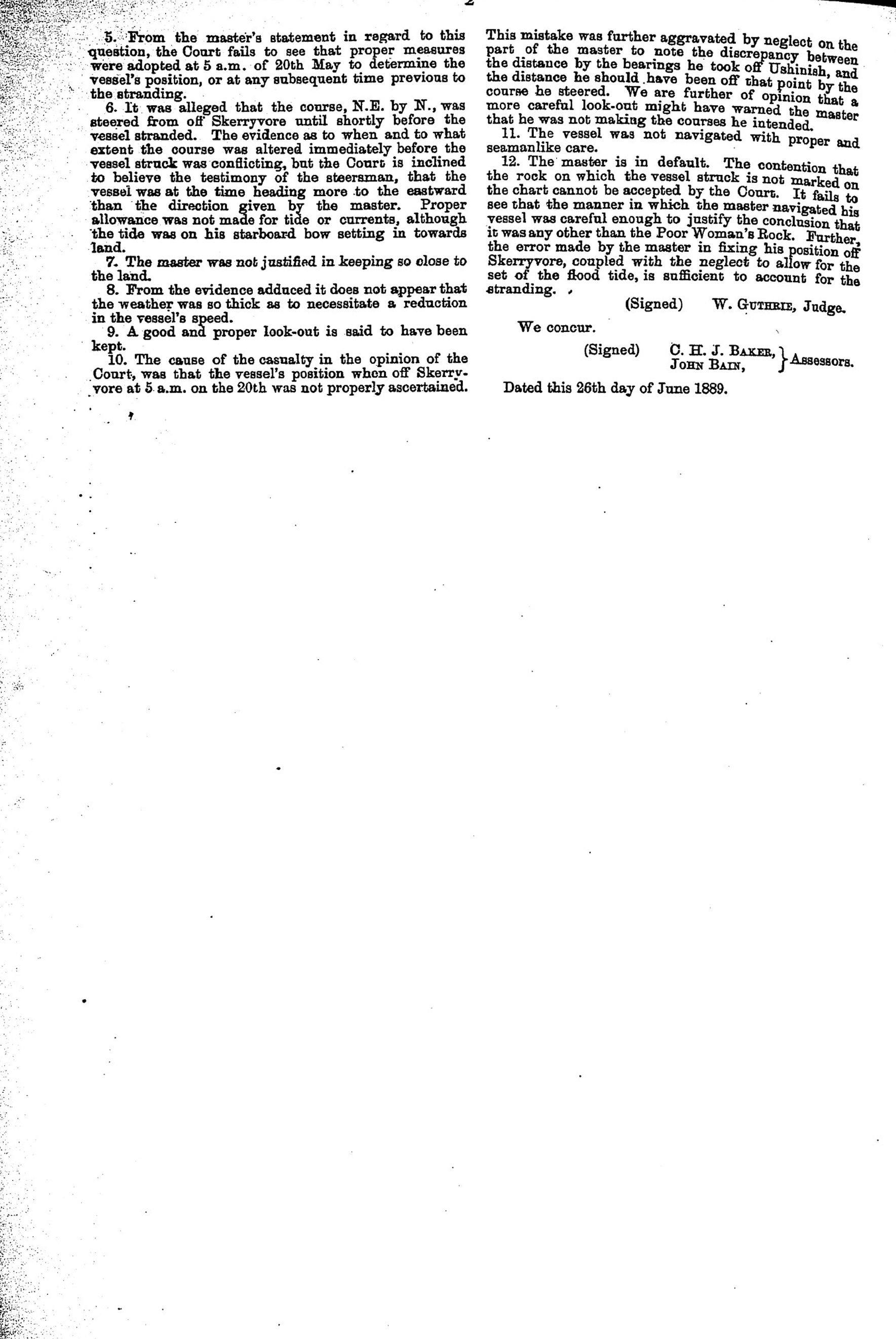
The subsequent enquiry into the loss found that the captain was to blame for her loss due to his failure to establish a accurate position for his vessel from the time he passed Skerryvore. Additionally the enquiry conclusion stated that, if a lookout had been properly assigned, the errors in navigation could have been mitigated and the reef spotted in time to avoid the stranding. Finally it also concluded that he had failed to adjust the course for the westerly set of the tide as they steamed north east along the coast of Harris. Captain Breater’s certificate was suspended for 12 months. However, at a later appeal, the court held that Captain Breater’s behaviour was not unusual on a voyage north through the Minch and, although there was clearly an error of judgement, the punishment was deemed too severe and should have been limited to a reprimand and caution. His certificate was returned