Scottish Shipwrecks

Information and Pictures of Shipwrecks in Scotland

  • Home
  • About
    • About Clyde Shipwrecks
    • About Argyll Shipwrecks
  • Shipwrecks
    • Scottish Shipwrecks
    • 1 – Galloway & Solway Firth
    • 2 – Clyde
    • 3 – Argyll
    • 4 – NW Scotland & Outer Hebrides
    • 5 – North Coast & Orkney Isles
    • 6 – Shetland Isles & Fair Isle
    • 7 – North East Scotland
    • 8 – East Scotland
    • 9 – South East Scotland
  • GALLERY
    • GALLERY INTRODUCTION
    • VINTAGE VIEWS
    • WRECKLIFE
    • WRECKSHOTS
    • WRECKCLIPS
  • Book Sale
    • Argyll Shipwrecks
    • Clyde Shipwrecks
  • Blog

SMS Munchen

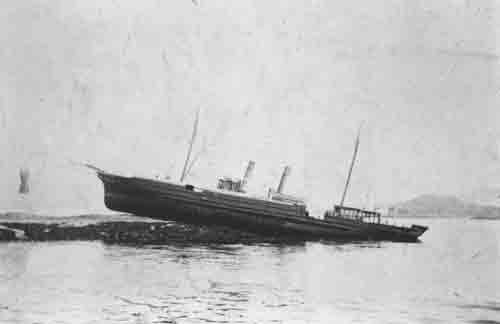
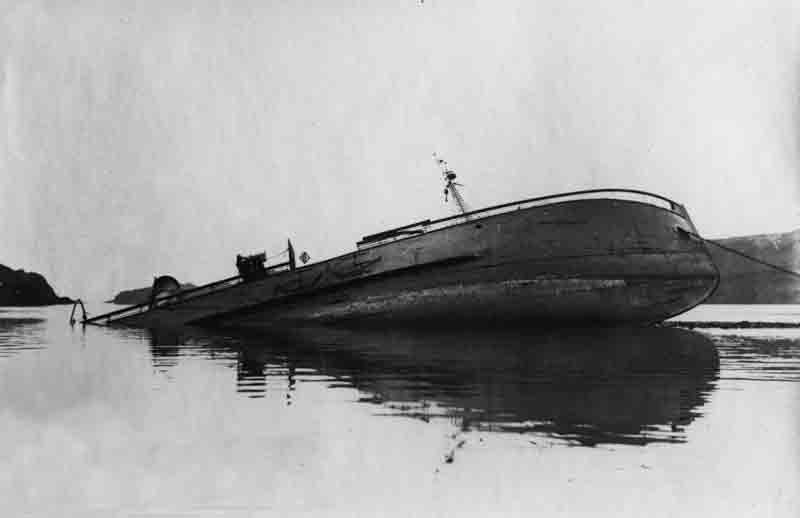
The Munchen was a steel light cruiser of the German Imperial Navy built at the Bremen yard of A G Weser (Yard No 138). On 30th April 1904 Prince Ludwig of Bavaria attended her launch by the mayor of the city of Munich, Councillor Baron of Borscht. She measured 364.7′ x 43.7′ x 18.4′ and displaced 3756 tons. She was powered by 2 triple expansion steam engines powered by 10 Schulz water tube steam boilers. Her two shafts delivered 11750 ihp. Her armament consisted of 10 × 10.5 cm quick firing guns, 10 × 5.3 cm quick firing guns and she had 2 × 45 cm torpedo tubes.

Munchen-portside
munchen-postcard
Munchen
She entered service on 10th January 1905 and, until the outbreak of World War I, exercised with other ships of the increasingly powerful German Navy. On 25th August 1914 she joined the 4th Scouting Division based in the Baltic Sea where she escaped unscathed from an engagement with four Russian battleships. In January 1916 she collided with and sank the German freighter Moscow of the Hanseatic Steamship GmbH. In March 1916, the Munchen was re-assigned to the North Sea and was to participate in the Battle of Jutland. She was hit twice as the two massive fleets blasted at each other and four of her crew were killed. As the German Fleet retreated at the end of the battle she was hit twice more and a further four men were killed and twenty wounded. She ship was repaired in Bremen and Wilhelmshaven and returned to service on the 30th June 1916. In the early morning of the 19th October 1916, while patrolling in the North Sea, she was hit by a torpedo from the British submarine HMS E-38. She survived the attack but was badly damaged and was never to return to active service. She ended her career in Germany as an accommodation ship.

On 6th July 1920 she was delivered to buyers in the UK to be scrapped. However this was destined not to be the final end for the Munchen as the hulk of the ship was delivered to the Royal Navy to be used as a target ship in torpedo experiments. She finally succumbed to these activities and sank in the Firth of Forth around the 17th September 1921.

The remains of the Munchen lie in position 56°07.295’N, 02°46.464’W in 54 metres oriented 090°/270° with bows pointing west. The extensive wreckage is still fairly in tact with her distinctive sloping bow, lying with a list to port, and stern section still clearly visible. The central section and engine room area are more broken, probably as a result of both the salvage efforts before she was sunk and the torpedo experiments in 1921. The least depth over the wreck is around 43-44 metres dependant on the state of the tide.

Share this:

  • Click to share on Facebook (Opens in new window) Facebook
  • Click to share on X (Opens in new window) X
  • More
  • Click to print (Opens in new window) Print
  • Click to email a link to a friend (Opens in new window) Email

Subscribe to Blog via Email

Enter your email address to subscribe to this blog and receive notifications of new posts by email.

Our Social Media Sites


Shipwreck Slideshow

Admiral Cordington Barcombe Belford Bombardier Brigadier Clydesdale Cormoran Coronella Dunira Grenadier Harald Hereford Express Islay Kathleen Stromboli Lapwing II Laverock Milewater Mountaineer Norse Paulina Hexpress Pirate Pretorian Princess Patricia Rondo Tyrconnel Agios Minas

Site built and hosted by Braveheart Webdesign Islay