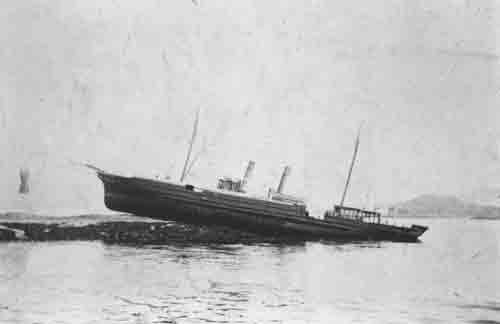
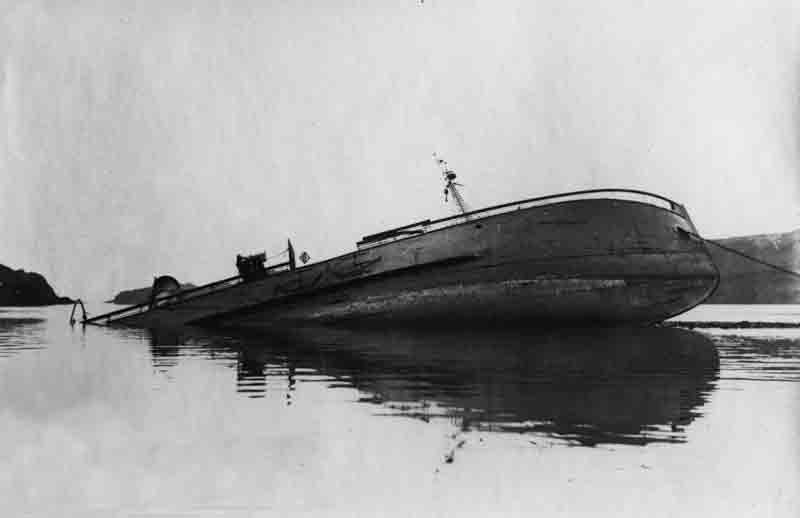
The steel steamship Katuna was built for the Bucknell Steamship Co Ltd by Armstrong Whitworth and Co. Ltd. of Newcastle. Launched on 27th February 1907 she measured 400.0′ x 52.1′ x 27.0′ and her tonnage was 4647 gross tons, 2912 net tons. She was powered by a triple expansion steam engine by Wallsend Slipway Co Ltd., Newcastle delivering 478 nominal horse power. This company was merged into the Ellerman Bucknell Company in 1914 who renamed her City of Swansea in 1929. In 1937 she was sold to the Barry Shipping Company who named her St Glen. This company changed it’s name to the South American Saint Line in 1939.
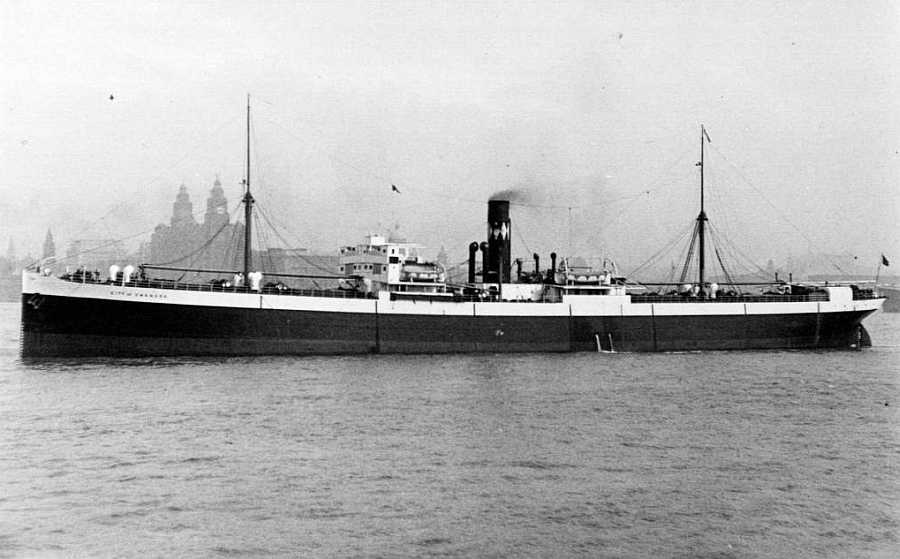
Steamship City of Swansea under way

Lloyds register 1939
Pressed into wartime service, and fitted with a defensive gun, the St Glen completed two voyages to South America and Freetown before she joined her final convoy, SL44 in August 1940. She had arrived in Freetown, Sierra Leone from Rosario and Buenos Aires with a general cargo including wheat, salted hides and other goods including a large consignment of 1339 tons of tinned corned beef. The convoy departed from Freetown on the 18th August bound for Liverpool. The convoy made it safely across the Bay of Biscay and north along the Irish west coast before dispersing in the North Channel. The majority of ships were bound for Liverpool but St Glen steamed north and through the Pentland Firth heading for Methil on the Firth of Forth.
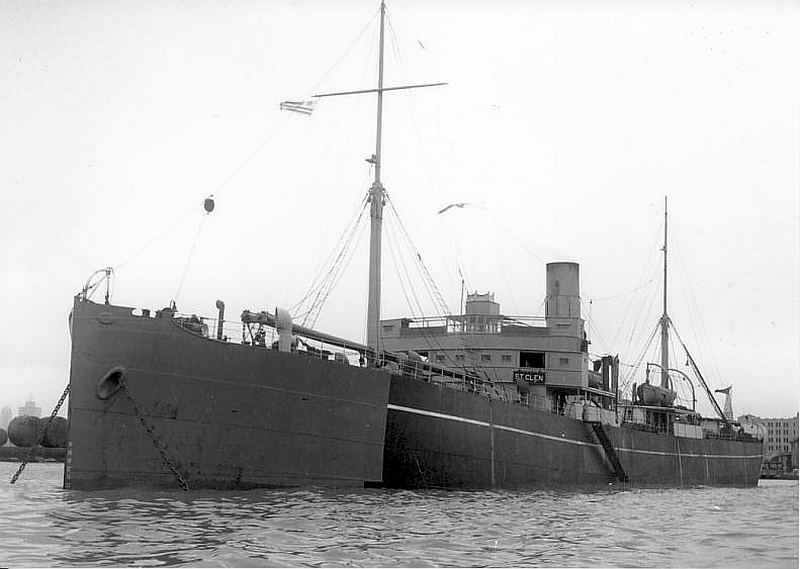
Steamship St Glen in her wartime livery
By the 6th September she was east of Buchan Ness when she was attacked by German dive bombers. One bomb scored a direct hit aft of the engine room killing three of the crew. The ship was fatally damaged and almost immediately broke in two pieces and sank. Thankfully the remaining forty crewmen were able to abandon ship before she went down and were picked up by HMS Sandwich.
The wreck of the St Glen was found and positively identified in March 2001. The position of the wreck had been noted by local fishermen who often pulled up tins of corned beef in their nets clearly identifying her as the St Glen. The wreck lies in position 57° 25.765’N, 001° 36.236’W (WGS84) oriented 070°/250° in 67 metres and rises around 10 metres from the seabed at it‘s highest point. The wreck lies in two pieces with the stern section well broken and collapsed although propeller shaft and propeller still clearly visible. The mid section is most in tact allowing access to holds and engine area. Forward the bow is upturned but still fairly in tact.
We would like to acknowledge the assistance of Buchan Divers – www.buchandivers.com in the preparation of this article.